
Back in 2017, Evolution Gaming looked at the casino industry and thought: “What if we made a wheel game, but actually made it fun to watch?” The result was Dream Catcher, the game that started this whole live game show revolution. Before Crazy Time, before Monopoly Live, before all the over-the-top bonus rounds and virtual worlds, there was just a simple wheel with numbers and multipliers. And honestly? It’s still one of the best games they’ve ever made.
Dream Catcher is what happens when you take a classic wheel of fortune, strip away all the unnecessary complexity, and focus on pure, simple gambling entertainment. No bonus rounds that take five minutes to resolve. No virtual worlds or animated characters. Just a wheel, a host, and the chance to win up to 40x your bet (or more, if the multipliers align). It’s elegant in its simplicity, and that’s exactly why it works so well.
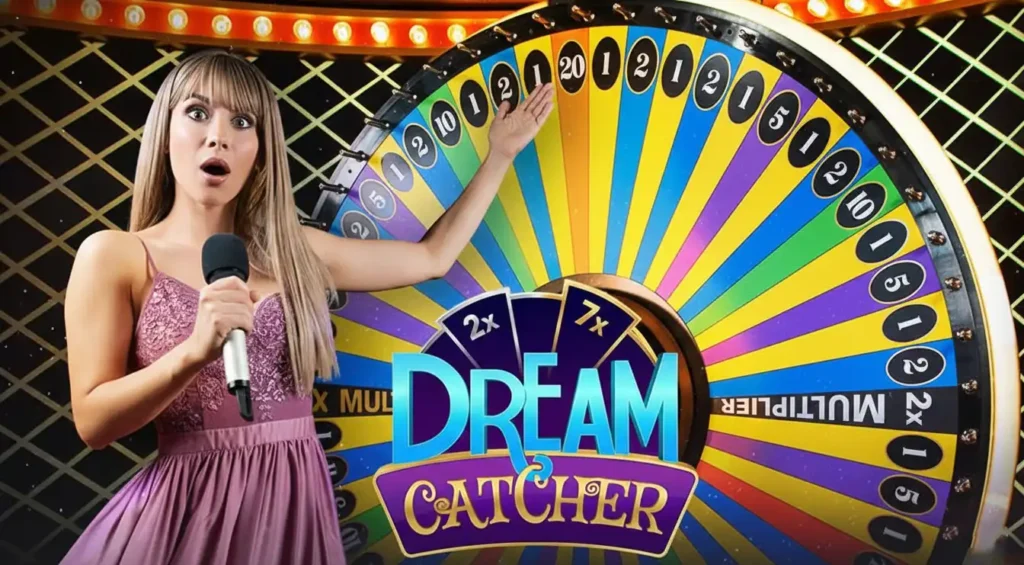
Dream Catcher is a vertical wheel game. That’s it. That’s the entire concept. Evolution took a giant wheel, divided it into 54 segments, marked them with numbers (1, 2, 5, 10, 20, 40) and two multipliers (2x and 7x), and said: “Here, bet on what you think it’ll land on.”
The wheel spins, it stops on a segment, and if you bet on that segment, you win. The payout matches the number: bet on 5, get 5:1. Bet on 40, get 40:1. It’s that straightforward. No complicated rules, no hidden mechanics, no “wait, what just happened?” moments. Just clean, simple gambling.
What makes Dream Catcher special isn’t the mechanics (they’re dead simple). It’s the execution. The production quality is solid, the hosts are engaging without being over-the-top, and the whole thing feels like you’re watching a TV game show from the comfort of your couch. Except you’re actually betting real money and the outcomes matter.
Let’s talk about what’s actually on that wheel. The 54 segments aren’t distributed evenly, which is important to understand if you want to make anything resembling an informed decision.
| Segment Type | Frequency | Payout | Percentage of Wheel |
|---|---|---|---|
| Number 1 | 23 segments | 1:1 | 42.6% |
| Number 2 | 15 segments | 2:1 | 27.8% |
| Number 5 | 7 segments | 5:1 | 13.0% |
| Number 10 | 4 segments | 10:1 | 7.4% |
| Number 20 | 2 segments | 20:1 | 3.7% |
| Number 40 | 1 segment | 40:1 | 1.9% |
| Multiplier 2x | 1 segment | Multiplier | 1.9% |
| Multiplier 7x | 1 segment | Multiplier | 1.9% |
So if you’re betting on number 1, you’ve got the best odds. Almost 43% of the wheel is covered by number 1 segments. But you’re only getting paid 1:1, which means you’re basically breaking even (before the house edge takes its cut). The higher numbers pay way better, but they’re significantly rarer. Number 40 only shows up on 1.9% of the wheel, which means you’re going to be waiting a while if that’s your strategy.
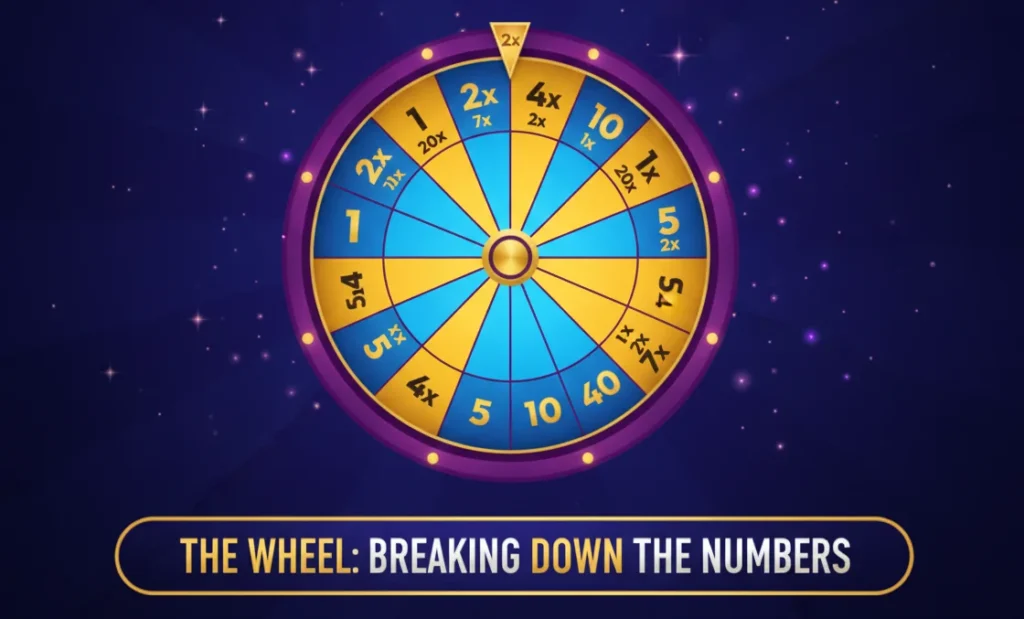
The multipliers are where things get interesting. They don’t pay out immediately. Instead, if the wheel lands on a multiplier, all bets stay active, and the wheel spins again. Whatever wins on that next spin gets multiplied by the multiplier. If it lands on another multiplier, the multipliers stack. So theoretically, you could hit 2x, then 7x, then land on 40, and walk away with 560x your bet. In practice, I’ve never seen multipliers stack more than twice, but it’s theoretically possible.
The Math: The RTP on Dream Catcher varies depending on which number you’re betting on. It ranges from about 90.67% (for number 40) up to 96.70% (for number 10). The number 1 bet has an RTP around 95.41%, which is actually pretty decent for a live casino game. But those high-paying numbers come with worse RTP, which is how the house edge works.
The multipliers are what separate Dream Catcher from your average wheel game. They’re not just another segment on the wheel. They’re game-changers that can turn a decent win into something special, or turn a disappointing spin into nothing at all.
When the wheel lands on a multiplier (2x or 7x), here’s what happens: nothing. At least, not immediately. All active bets stay exactly where they are. The wheel doesn’t reset. The host just spins it again, and whatever number wins on that next spin gets multiplied by the multiplier.
So if you bet $10 on number 5, the wheel hits 2x, then lands on 5, you get $50 times 2, which is $100. A 10:1 payout instead of 5:1. Not bad.
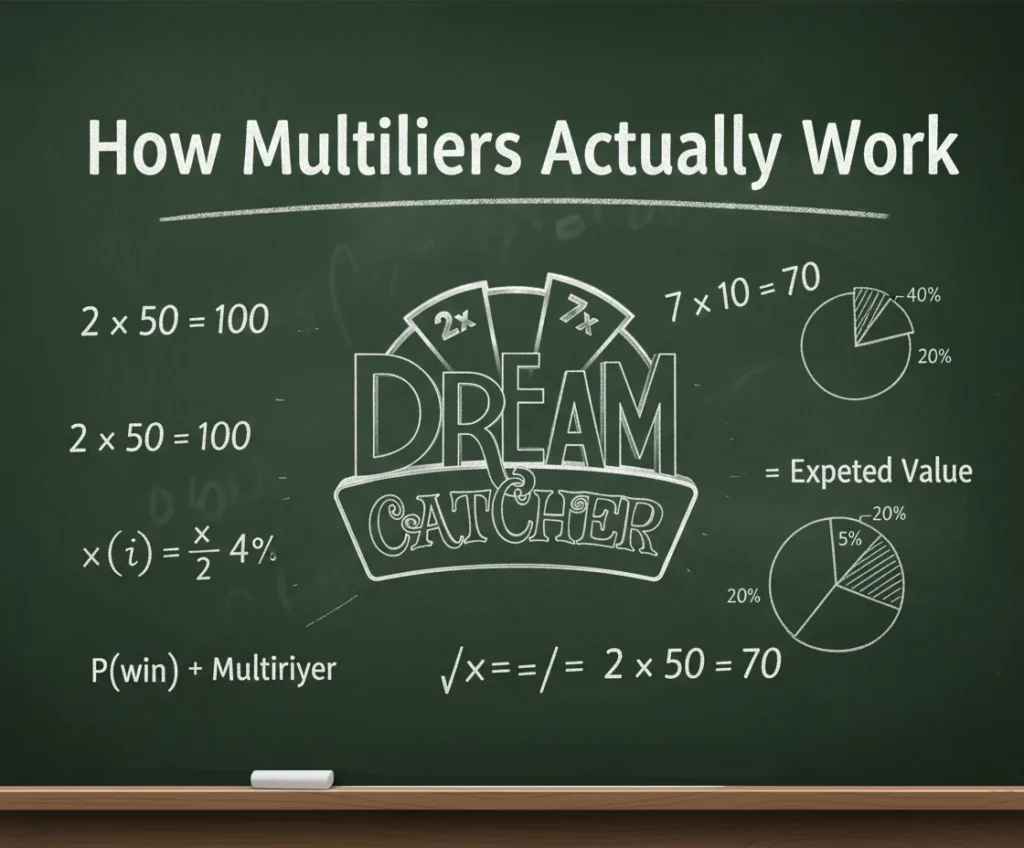
But here’s the catch: if the wheel hits a multiplier, then lands on a number you didn’t bet on, you get nothing. The multiplier doesn’t matter if your number doesn’t win. I’ve watched the wheel hit 7x, then land on 40 (which I didn’t bet on), and I felt personally attacked by probability.
The multipliers can also stack. If the wheel hits 2x, then hits 7x, then lands on 10, that’s a 10:1 payout multiplied by 2, then by 7, which is 140:1. I’ve seen this happen exactly once in hundreds of hours of play, and it was glorious. But don’t count on it.
The 2x multiplier shows up 1.9% of the time. The 7x multiplier also shows up 1.9% of the time. Combined, that’s about 3.8% chance of hitting a multiplier on any given spin. But remember, hitting a multiplier doesn’t guarantee you’ll win. It just guarantees that if you do win, your payout gets multiplied.
I’ve developed a love-hate relationship with multipliers. When they work in your favor, they’re amazing. When they don’t, they’re just another way to lose money while getting your hopes up. The 7x multiplier landing, then the wheel hitting a number you didn’t bet on, is one of the most frustrating experiences in online gambling. You were so close to something special, and then you got nothing.
RTP (Return to Player) isn’t just some abstract concept that doesn’t matter. It’s the mathematical expectation of what you’ll get back over the long run. And in Dream Catcher, the RTP varies significantly depending on which number you’re betting on.
| Number | RTP | House Edge | Frequency |
|---|---|---|---|
| 1 | 95.41% | 4.59% | 42.6% |
| 2 | 95.60% | 4.40% | 27.8% |
| 5 | 91.34% | 8.66% | 13.0% |
| 10 | 96.70% | 3.30% | 7.4% |
| 20 | 92.86% | 7.14% | 3.7% |
| 40 | 90.67% | 9.33% | 1.9% |
Look at that table. Number 10 has the best RTP at 96.70%. That’s actually really good for a live casino game. But it only shows up 7.4% of the time, which means you’re going to lose most of your spins. Number 1 has a decent RTP (95.41%) and shows up almost 43% of the time, which means you’ll win more often, but the payouts are smaller.
The high-paying numbers (20 and 40) have worse RTP because the house edge is built into the payout structure. They pay better, but the math is working against you more. Number 40 has an RTP of 90.67%, which means over the long run, you’re losing almost 10% of what you bet. That’s not great, but if you’re looking for big wins and you understand the risk, it’s an option.
Here’s the thing about RTP: it only matters over thousands of spins. In a single session, you could bet on number 40, hit it twice, and walk away ahead. Or you could bet on number 1, never hit it, and lose everything. RTP tells you what will happen in the long run, but it doesn’t guarantee anything in the short term.

My Personal Experience: I’ve spent hours betting on number 10 because of its high RTP. In theory, it’s the best bet. In practice, I’ve gone entire sessions without hitting it once, because 7.4% odds mean you’re going to lose a lot more often than you win. The RTP is great, but the volatility is real, and it doesn’t care about your bankroll management.
Here’s the uncomfortable truth: Dream Catcher is essentially random. The wheel spins, it stops somewhere, and there’s no way to predict where. You can’t count cards, you can’t track patterns, and you can’t use skill to influence the outcome. Each spin is independent, and the wheel doesn’t remember what happened before.
That said, there are some things you can do to maximize your enjoyment and minimize your losses (relatively speaking).
The multipliers are exciting, but you can’t actually bet on them directly. They just happen (or don’t). So your strategy should focus on which numbers to bet on, not on trying to predict multipliers.
If you want the best RTP, bet on number 10. It has a 96.70% RTP, which is excellent. But remember, it only hits 7.4% of the time, so you’re going to lose a lot of spins before you win. If you want more frequent wins (even if they’re smaller), bet on number 1 or 2. They have decent RTP and hit much more often.
If you’re feeling lucky and want to chase big wins, number 40 pays 40:1. But the RTP is only 90.67%, and it only hits 1.9% of the time. You’re basically playing the lottery at that point.
Set a budget. Stick to it. This should be obvious, but I’ll say it anyway because it’s the most important strategy for any casino game. Dream Catcher can be deceptively fast-paced. The spins happen quickly, the hosts keep the energy high, and before you know it, you’ve been playing for an hour and your bankroll is gone.
I recommend betting small amounts consistently rather than going all-in on high-paying numbers. If you bet $5 on number 40 every spin, you’re going to lose 98.1% of the time. That’s not sustainable. Bet smaller amounts on numbers with better frequency, and occasionally throw a small bet on the high-paying numbers if you want the excitement.
Some players like to watch the game for a while before betting, trying to identify “cold streaks” or “hot numbers.” Here’s what you need to know: there are no streaks. Each spin is independent. The wheel doesn’t remember that number 40 just hit. The odds are exactly the same every single spin.
If number 1 just hit three times in a row, the odds of it hitting again are still 42.6%. Not higher, not lower. Exactly the same. The wheel doesn’t care about patterns or streaks. It’s just physics and random number generation.
That said, watching for a while can help you understand the game better and set realistic expectations. But don’t fall into the trap of thinking you can predict outcomes based on previous results.
Since Dream Catcher came first and Crazy Time is basically its over-caffeinated younger sibling, let’s compare them briefly. Dream Catcher is simple, clean, and straightforward. Crazy Time is complex, flashy, and overwhelming. Dream Catcher has two multipliers and straightforward payouts. Crazy Time has four bonus rounds and multipliers that can theoretically hit 20,000x.
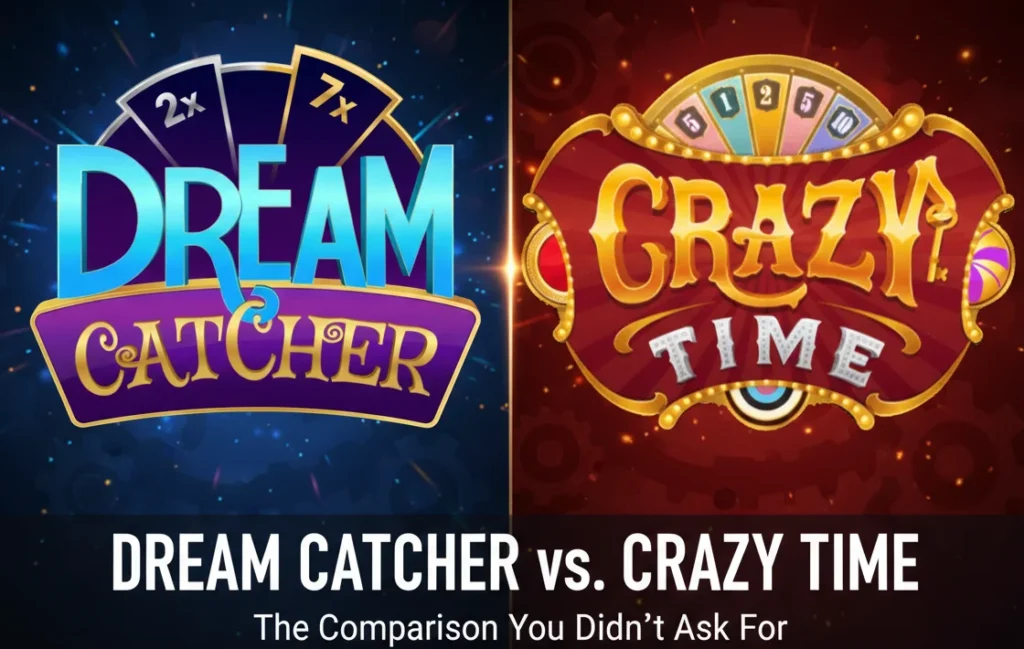
Which is better? It depends on what you’re looking for. If you want simplicity and decent RTP, Dream Catcher is your game. If you want entertainment value and the chance (however slim) of hitting something massive, Crazy Time might be more your speed.
Personally, I appreciate Dream Catcher more. It does one thing, and it does it well. There’s no unnecessary complexity, no five-minute bonus rounds that could have been resolved in thirty seconds, no virtual worlds or animated characters. Just a wheel, some numbers, and the chance to win money. Sometimes the simple solution is the best solution.
Here’s my honest take: Dream Catcher is a solid, well-designed game that knows exactly what it is. It doesn’t try to be flashy or revolutionary. It just tries to be a good wheel game, and it succeeds.
Dream Catcher might not be the flashiest game in Evolution’s lineup, but it’s one of the most honest. It doesn’t pretend to be something it’s not. It’s a wheel game, and it’s an excellent wheel game. The rules are clear, the RTP is decent (depending on what you bet on), and the execution is solid.
It’s the game that started this whole live game show trend, and you can see why it worked. It’s simple enough to understand immediately, exciting enough to keep you engaged, and fair enough (in terms of RTP) that you don’t feel completely ripped off.
If you’re looking for a straightforward, no-nonsense gambling experience, Dream Catcher is worth your time. Just understand the odds, set a budget, and don’t get too attached to those multipliers. They’ll break your heart more often than they’ll make you rich.
I’ll keep playing it, because sometimes you want simplicity. Sometimes you want a game that doesn’t try too hard. Sometimes you just want to watch a wheel spin and hope for the best. Dream Catcher delivers exactly that, and honestly, that’s enough.
The base maximum payout is 40:1 if you bet on number 40 and it wins. However, if multipliers stack (which is rare), the payout can theoretically be much higher. For example, if the wheel hits 2x, then 7x, then lands on 40, that’s 40 times 2 times 7, which is 560:1. But don’t count on it.
Number 10 has the best RTP at 96.70%, but it only hits 7.4% of the time. Number 1 has a decent RTP (95.41%) and hits almost 43% of the time, so you’ll win more frequently but get smaller payouts. There’s no single “best” number. It depends on whether you prioritize RTP, frequency of wins, or potential payout size.
Not really. The game is essentially random. Each spin is independent, and there’s no way to influence the outcome. The best “strategy” is bankroll management: set a budget, bet small amounts consistently, and don’t chase losses.
No, Dream Catcher is not rigged. Evolution Gaming is a reputable provider licensed in multiple jurisdictions. The game uses random number generators to determine outcomes, and it’s regularly tested by independent agencies. The house edge is built into the game mechanics (the RTP), but the outcomes themselves are random and fair.
Yes, Dream Catcher is fully optimized for mobile devices. The game works on both iOS and Android devices, and the vertical wheel format actually works really well on mobile screens. All betting options are accessible, and the interface is touch-friendly.

Hi everyone, my name is Kevin and I am an author and creative manager at wagermaniacs.com. I have extensive experience in the field of gambling, as well as more than 15 years of experience playing in online casinos. These two facts allow me to be called a real expert in the field of iGaming.
My favourite online casinos: Vavada, Casino-X, Riobet and Mostbet
 Promo code: CENTR
 Welcome Bonus $300
 Welcome Bonus $100 + 180 Free spins
 Welcome Bonus Up to 150% + 500 Free spins
 Welcome Bonus $1000 + 100 Free spins