 Vavada Casino
100% + 100 Free Spins
Visit Casino
Read Review
Vavada Casino
100% + 100 Free Spins
Visit Casino
Read Review

An actual explanation of how casino payouts work, where the money goes, what casinos do behind your back with payout settings, and how to protect yourself from getting shortchanged. If you play at online casinos and you’ve never thought about any of this, you’re probably leaving money on the table. Literally.
We also recommend that you read:
I lost $ 5,400 in about forty minutes once. Not because I was being reckless or chasing losses like an idiot. I was playing a slot I liked, betting small, doing everything “right.” But the slot was running at 88% RTP. I didn’t know that at the time. I didn’t even know what RTP meant. I just kept spinning and watching my balance melt like ice cream on asphalt in July, thinking I was having a bad luck streak. Turns out, it wasn’t luck. It was math. The game was designed to eat money at that pace, and I was happily feeding it.
That session taught me something I wish someone had told me years earlier: not all casino games are built equal, and the casino you play at can make the same game pay out differently. A couple of percentage points on a payout rate sounds like nothing until you sit there for two hours and realize your bankroll vanished twice as fast as it should have. The difference between a highest payout casino and a stingy one isn’t marketing or vibes. It’s cold, hard numbers hiding behind the same flashy graphics.
So this is going to be the page I wish I’d found back then. Not a list of games with percentages slapped next to them.
Vavada Casino
100% + 100 Free Spins
Visit Casino
Read Review
 SOL Casino
50% bonus up to 300$
Visit Casino
Read Review
SOL Casino
50% bonus up to 300$
Visit Casino
Read Review
 Fresh Casino
100% up to 300$ + 200 FS
Visit Casino
Read Review
Fresh Casino
100% up to 300$ + 200 FS
Visit Casino
Read Review
 BitStarz Casino
Big catalogue of games
Visit Casino
Read Review
BitStarz Casino
Big catalogue of games
Visit Casino
Read Review
 Stake Casino
Rakeback + Weekly Raffle
Visit Casino
Read Review
Stake Casino
Rakeback + Weekly Raffle
Visit Casino
Read Review
 1xSlots
150% up to 300$ + 100 FS
Visit Casino
Read Review
1xSlots
150% up to 300$ + 100 FS
Visit Casino
Read Review
 Beef Casino
50% + 600 Free Spins
Visit Casino
Read Review
Beef Casino
50% + 600 Free Spins
Visit Casino
Read Review
 Joycasino
$2000 Welcome Package
Visit Casino
Read Review
Joycasino
$2000 Welcome Package
Visit Casino
Read Review
 Casino-X
Up to $2000 Welcome Package
Visit Casino
Read Review
Casino-X
Up to $2000 Welcome Package
Visit Casino
Read Review
 Mostbet
125% Maximum $300 bonus
Visit Casino
Read Review
Mostbet
125% Maximum $300 bonus
Visit Casino
Read Review
 LEX Casino
200% Up to $400
Visit Casino
Read Review
LEX Casino
200% Up to $400
Visit Casino
Read Review
 Ramenbet
up to $1,500 Welcome Bonus
Visit Casino
Read Review
Ramenbet
up to $1,500 Welcome Bonus
Visit Casino
Read Review
 Jet Casino
50% bonus up to 300$
Visit Casino
Read Review
Jet Casino
50% bonus up to 300$
Visit Casino
Read Review
 Flagman Casino
150% for the First Deposit
Visit Casino
Read Review
Flagman Casino
150% for the First Deposit
Visit Casino
Read Review
 Monro Casino
Up to 50% on First Deposit
Visit Casino
Read Review
Monro Casino
Up to 50% on First Deposit
Visit Casino
Read Review
RTP stands for Return to Player. It’s a percentage. If a game has 96% RTP, that means for every $100 that goes through the game over its lifetime, $96 gets paid back to players and $4 stays with the casino. That $4 is called the house edge. RTP and house edge are just two sides of the same number. 96% RTP equals 4% house edge. They always add up to 100.
Now here’s where people get confused, and I was one of them for a long time. RTP doesn’t apply to your deposit. It applies to your total wagers. If you deposit $100 and play slots, you’re not going to end up with $96 after one round of betting. What actually happens is you bet that $100, win some back, bet the winnings, win some more, lose some, and this cycle continues. By the time you’re done playing, you might have wagered $500 or $1,000 total even though you only deposited $100. The 96% applies to that entire churn of money through the machine.
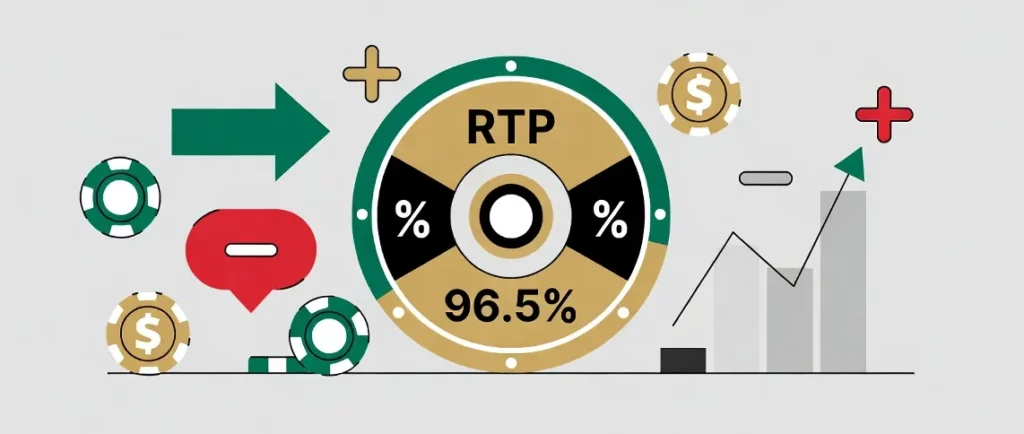
The other thing that trips people up is timeframe. RTP is a theoretical calculation based on millions of spins. Your personal session might look nothing like the stated percentage. You could play a 99% RTP game and walk away broke. You could play a 90% RTP game and hit a jackpot. That’s variance doing its thing. But over thousands of hours and millions of spins across all players, the math converges. The game pays back almost exactly what the RTP says it will. So while you can’t predict your individual session, you can absolutely predict which games will eat your bankroll faster over time. And that matters if you play regularly.
Let me put it in terms that actually make sense. Say you play slots for two hours. You’re doing about 600 spins per hour at $1 each. That’s $1,200 wagered total. At 96% RTP, you’d expect to lose about $48. At 94% RTP, you’d lose about $72. Same time, same bet size, same game types, but $24 more gone because the payout percentage was 2 points lower. Do that every weekend for a year and you’re looking at over a thousand dollars difference. That’s not a rounding error. That’s real money.
This is the part that made me genuinely angry when I first learned about it, and I think every player deserves to know.
When Pragmatic Play builds a slot like Gates of Olympus, they don’t create one version. They create three. One at 96.50% RTP. One at 95.50%. And one at 94.50%. All three are certified separately by testing labs. The game looks identical in every version. Same Zeus, same multipliers, same tumbling mechanic. But the payout tables are weighted differently so that over time, the lower versions keep more money for the casino.

The casino then picks which version to run on their platform. And most players have absolutely no idea this is happening. You open Gates of Olympus at Casino A and it’s running at 96.50%. You open the exact same game at Casino B and it’s at 94.50%. Visually, there is zero difference. The buttons are the same. The sounds are the same. The bonus feature triggers the same way. But one version is taking 50% more of your money per spin on a mathematical level.
Pragmatic Play isn’t the only studio that does this. Play’n GO ships their slots with multiple RTP tiers too, and so does Hacksaw Gaming. Nolimit City offers variable versions as well. The gap is usually 2 percentage points between the highest and lowest available setting, which sounds small but absolutely is not small over any meaningful volume of play.
There are exceptions. Some studios ship their games at a single fixed RTP that the casino can’t touch. Thunderkick does this. Their slots are what they are. Endorphina also keeps things relatively locked down. When you see a Thunderkick game, you can trust the published RTP because nobody had the option to lower it. That’s worth remembering.
How do you check which version you’re playing? It’s simpler than you’d think, and it takes about thirty seconds.
Most online casino players stick to slots. Makes sense. Slots are colorful, exciting, easy to play, and the bonus rounds feel like mini events. But from a pure payout perspective, slots are not your best bet. Not even close.
Blackjack with basic strategy gives the casino a house edge as low as 0.28%. That translates to roughly 99.7% RTP. You read that right. For every $100 you wager optimally at a blackjack table, you’d lose about 28 cents on average. Of course, “basic strategy” means you need to memorize the correct play for every possible hand, but it’s not that hard. There are free charts all over the internet, and after a few sessions, the decisions become automatic. Compare that to a typical slot at 96% where you’re losing $4 per $100 wagered, and the difference is staggering. Blackjack players are playing an entirely different financial game than slot spinners.
Baccarat is another strong option. The banker bet carries a 1.06% house edge, which is about 98.9% RTP. No strategy needed. You literally just bet on banker every hand and you’re playing near-optimal. The player bet is slightly worse at 1.24% edge, and the tie bet is a trap at over 14% house edge. But for pure simplicity combined with low house advantage, baccarat banker is hard to beat.
French roulette with the La Partage rule cuts the house edge on even-money bets to 1.35%, giving you 98.65% RTP. European roulette sits at 2.7% edge (97.3% RTP), which is still solid. American roulette with its double zero bumps the edge to 5.26%, which is terrible. Never play American roulette if the European version is available. There’s no upside and a significant downside.
Then you’ve got crash games. Aviator, Plinko, JetX. These typically run at 97% RTP, and some crypto-native crash games hit 99%. What makes them interesting beyond the numbers is provably fair verification. Every round can be checked with cryptographic hashes, so you can actually verify the casino isn’t cheating. For a crash game at 97 to 99% RTP with transparent math, that’s a better deal than almost any slot on the market.
And at the bottom of the barrel: keno and scratch cards. House edges of 15 to 25%. These games exist to print money for the casino. If you enjoy them, that’s your business, but don’t play them expecting your balance to last.
| Game | RTP | House Edge | Skill Required |
|---|---|---|---|
| Blackjack (basic strategy) | 99.2% – 99.7% | 0.28% – 0.8% | Yes |
| Baccarat (banker) | 98.94% | 1.06% | No |
| French Roulette (La Partage) | 98.65% | 1.35% | No |
| Crash Games (Aviator, Plinko) | 97% – 99% | 1% – 3% | Strategy helps |
| European Roulette | 97.3% | 2.7% | No |
| High RTP Slots (top tier) | 97% – 99% | 1% – 3% | No |
| Average Slots | 95% – 96.5% | 3.5% – 5% | No |
| American Roulette | 94.74% | 5.26% | No |
| Keno / Scratch Cards | 75% – 85% | 15% – 25% | No |
NetEnt built some of the highest-paying slots in online casino history. Mega Joker sits at 99% RTP, which is absurd for a slot machine. Jackpot 6000 runs at 98.86%. Blood Suckers is at 98%. These are real, certified numbers from an era when studios used high RTP as a selling point rather than max win multipliers.
| Slot | Provider | RTP | Volatility | Max Win |
|---|---|---|---|---|
| Mega Joker | NetEnt | 99.00% | Low | 2,000x |
| 1429 Uncharted Seas | Thunderkick | 98.50% | Low | 670x |
| Blood Suckers | NetEnt | 98.00% | Low | 1,015x |
| Starmania | NextGen | 97.87% | Low-Medium | 1,000x |
| White Rabbit Megaways | Big Time Gaming | 97.72% | High | 13,000x |
The catch? Almost all of these high-RTP slots are low volatility with modest maximum wins. Mega Joker caps out at 2,000x. Blood Suckers maxes at about 1,015x. Compare that to modern high-volatility slots like San Quentin (150,000x max win) or Wanted Dead or a Wild (12,500x max win), and you can see the trade-off. High RTP and extreme max win potential don’t coexist in the same slot. The math simply doesn’t allow it. If a game is giving back 99% of all money played, there isn’t enough margin left to fund a 50,000x payout for someone. The money has to come from somewhere.
So the decision comes down to what you want from your session. If you want your bankroll to survive as long as possible with small, frequent wins, the classic high-RTP NetEnt slots are perfect for that. Starburst at 96.09% with low volatility is a classic example of a slot that keeps you playing for a long time without dramatic swings. If you want the adrenaline of chasing a massive multiplier and you’re fine with losing more sessions than you win, the modern high-volatility games from Nolimit City, Hacksaw Gaming, and Pragmatic Play are where you’ll find that action. Just make sure the RTP is at least 96% at your casino, not the reduced version.
Most popular slots from modern providers sit in the 96 to 96.5% RTP range at their default settings. Sweet Bonanza defaults to 96.48%. Book of Dead defaults to 96.21%. Reactoonz sits at 96.51%. The Dog House Megaways at 96.55%. These are all fine numbers if the casino is running the default version. They become problematic when the casino drops them to 94%. Always check.
| Popular Slot | Provider | Best RTP | Worst RTP | Difference |
|---|---|---|---|---|
| Gates of Olympus | Pragmatic Play | 96.50% | 94.50% | 2.00% |
| Sweet Bonanza | Pragmatic Play | 96.48% | 94.48% | 2.00% |
| Book of Dead | Play’n GO | 96.21% | 94.25% | 1.96% |
| Wanted Dead or a Wild | Hacksaw Gaming | 96.38% | 94.30% | 2.08% |
| San Quentin | Nolimit City | 96.03% | 94.03% | 2.00% |
| Starburst | NetEnt | 96.09% | 96.09% | 0% (fixed) |
RTP tells you how much money comes back to players over the long run. Volatility tells you how that money comes back. Two slots can both have 96% RTP and give you completely opposite experiences.
A low-volatility slot pays you something every few spins. The wins are small, your balance barely moves, and you can play for hours on a modest bankroll. It feels safe, predictable, maybe even a bit boring if you’re the type who needs excitement. But your money lasts. These are the slots you want when you’re clearing a wagering requirement on a bonus, because you’re less likely to bust out before you hit the target.
A high-volatility slot eats your balance for fifty, a hundred, sometimes two hundred dead spins in a row. Then it drops a bonus round that pays 500x your bet, and suddenly you’re way up. Or the bonus round pays 15x and you’re still in the hole. That’s the nature of high variance. The wins are less frequent but much larger when they land. Your session could end at zero or at ten times your starting balance. There’s no middle ground. This is what Gates of Olympus does. It’s what Mental does. It’s why people record their screens and post clips of 10,000x wins on the internet. But for every clip like that, there are hundreds of sessions that ended with nothing.
If you care about getting the most playtime for your money, combine high RTP with low volatility. If you care about the chance to score a big payout, go with high volatility but insist on at least 96% RTP. The worst possible combination is low RTP and high volatility, because you’re bleeding money faster than average and also getting hammered by variance. Some branded tie-in slots land in exactly this category. They rely on the brand name to attract players while offering objectively bad odds.
This is something I never see discussed properly in payout guides, and it genuinely changes the math.
Let’s say you deposit $100 and get a 100% match bonus. Now you have $200 to play with, but the bonus has a 35x wagering requirement on the bonus amount. That means you need to wager $3,500 before you can withdraw anything. At 96% RTP, you’d expect to lose about $140 over $3,500 in wagers (4% of $3,500). You started with $200. After meeting the requirement, you’d have around $60 left. That’s actually worse than if you’d just played with your original $100 and no bonus at all, where your expected loss from a single play-through would be only $4.
That’s the trap. A bonus that looks generous on the surface can actually decrease your effective return if the wagering requirement is too high. The breakeven point depends on the RTP of the games you play and the wagering multiplier. Lower wagering and higher RTP make bonuses profitable. Higher wagering and lower RTP make them money pits.
On the other hand, cashback bonuses with no wagering requirement are pure gold from a payout perspective. If a casino gives you 10% of your losses back with no strings, that’s a flat 10% boost to your effective return. A 96% RTP slot with 10% cashback is effectively running at a much better rate for you. Rakeback works similarly, returning a percentage of your total wagers regardless of whether you won or lost. These bonus types genuinely improve your odds. High-wagering deposit bonuses often don’t.
Here’s how I rank bonus types from a payout perspective, best to worst:
Before you claim any bonus, think about whether it actually improves your position or just locks you into more gambling than you planned. Sometimes the best bonus is no bonus at all.
There’s no foolproof way to tell from the outside, but certain patterns should make you suspicious.
There’s a reason crypto casinos come up in every conversation about high payouts. Many of them develop their own original games with house edges as low as 1%. Crash games, dice games, mines, tower climbers. These in-house titles often offer the best mathematical value in the entire casino because the operator controls the math directly and uses low edges to attract volume.
But here’s the thing people miss: a crypto casino running a Pragmatic Play slot can set it to 94.50% just as easily as any traditional casino. Being crypto doesn’t automatically mean better payout rates on third-party games. It depends entirely on the operator’s choice. Some crypto casinos run everything at the highest available RTP. Others don’t.
Where crypto casinos do shine is payout speed. Getting your money out fast matters because the longer it sits in your casino balance, the more likely you are to keep playing and give it back. A USDT withdrawal that hits your wallet in five minutes protects your winnings from your own impulses in a way that a three-day bank transfer never can.
After years of playing and losing and learning, here’s what I actually do when I’m evaluating a new casino from a payout perspective.
First, I open three or four popular slots and check the RTP in the game info panel. I specifically look at Pragmatic Play titles because they have the widest RTP spread (96.50% vs 94.50%). If the casino is running Pragmatic games at 96.50%, they’re probably running everything at the highest available setting. If they’re running Pragmatic at 94.50%, assume the worst for every other provider too.
Second, I check whether the casino offers cashback or rakeback. These bonus types are a direct boost to effective payout, and casinos that offer them tend to be more player-friendly across the board. A casino that gives you money back isn’t afraid of you playing a lot, which usually means they’re running fair games.
Third, I test the withdrawal process with a small amount. Speed matters, but it also tells you something about the operation. A casino that processes your $50 test withdrawal in ten minutes is very different from one that holds it for three days “pending review.” The first one trusts their own system. The second one is stalling, and that stalling might extend to larger amounts.
Fourth, I read what other players say. Not the paid reviews, not the affiliate sites. The actual forum posts and Reddit threads where real people talk about their experiences. If multiple unrelated players are complaining about games feeling rigged or withdrawals getting stuck, I move on. Life’s too short to fight with a casino’s support team over money they owe you.
Fifth, and this one took me too long to learn: I pick games I actually enjoy at an RTP I’m comfortable with, rather than grinding a high-RTP game I hate. Playing Blood Suckers at 98% for three hours when I’m bored out of my mind leads to bigger bets, longer sessions, and worse decisions. Playing Rise of Olympus at 96% for an hour while having a great time, then walking away, is better for my wallet every single time. The best strategy isn’t just mathematical. It’s behavioral.
I’ve heard every single one of these from other players, and they’re all wrong. Some of them cost me money before I knew better.
This is the gambler’s fallacy and it’s the most expensive belief in gambling. Every spin is independent. The random number generator has no memory. A slot that just paid a 5,000x jackpot has the exact same probability of paying another jackpot on the next spin as one that’s been dead for 500 rounds. The machine doesn’t know what happened before, and it doesn’t care.
No. The RTP and the random number generator don’t change based on time of day, number of active players, server load, or whether it’s a Tuesday. The only thing that changes RTP is the casino selecting a different certified version, and that’s a server configuration change, not a real-time toggle.
Almost always false for modern video slots. The RTP is the same at $0.20 per spin as it is at $200. There’s one notable exception: some classic NetEnt slots like Mega Joker have a supermeter mode at max bet that genuinely increases the RTP. But for 99% of games you’ll encounter, bet size has zero effect on your return rate.
Impossible. Changing the RTP version requires a server-side update from the game provider. It’s not a switch anyone flips mid-session. Regulators would shut a casino down instantly for doing this. The version is set when the game is integrated into the casino’s platform, and changing it is a process that involves the provider.
Also wrong, for the same reason as the gambler’s fallacy. The game doesn’t compensate. It doesn’t balance. It doesn’t target individual players. Each spin is its own independent event with the same odds as every other spin, regardless of your recent results.
Live casino games are interesting from a payout perspective because their RTP is fixed by the rules of the game, not by casino configuration. A live European roulette table has a 2.7% house edge because there are 37 numbers on the wheel and the payouts are structured around 36. That math is built into the physical setup. The casino can’t change it.
Live blackjack gives you up to 99.5% RTP with basic strategy. Live baccarat banker bet sits at 98.94%. These are genuinely some of the best odds in any casino, and unlike slots, the casino can’t secretly run a lower-paying version. The rules are the rules.
Live game shows like Crazy Time, Dream Catcher, and Mega Wheel are the exception. They’re entertainment products first and gambling products second, with house edges ranging from about 3% to 10% depending on which bets you place. The main wheel on Crazy Time carries roughly 96% RTP, but some of the side bets and bonus sectors have significantly lower returns. They’re fun to watch and play, but from a pure value standpoint, you’re better off at a blackjack table.
Picking a highest payout casino comes down to a few things that aren’t hard to check but that most people never bother checking. Look at the RTP your casino is actually running on popular slots. Understand which game types give better odds if you care about making your money last. Factor in bonuses not by how big they look but by how they actually affect your math. And play games you enjoy at stakes you’re comfortable with, because no payout percentage in the world saves you from chasing losses at 3 AM.
The information is out there. The numbers are in the game info panel. The choice of which casino to trust with your money is yours. Just make it an informed one.
Above 96% is solid. Above 97% is great. Above 98% puts a slot in the top tier worldwide. Below 95% means the casino is keeping a bigger cut than average. Below 93% is poor and usually found in branded slots or progressive jackpot games where part of each bet feeds the jackpot pool.
Yes. Many providers create multiple certified versions of each slot. Pragmatic Play typically offers 96.50%, 95.50%, and 94.50% variants. The casino picks which one to run. The game looks and plays the same regardless of version. You have to check the game info panel to see which RTP is active.
It means you’ll lose less on average over a large number of bets. Individual sessions are governed by variance, not RTP. You can absolutely lose money on a 99% slot and win big on a 90% slot in any given session. But over time and volume, higher RTP measurably reduces your losses.
Money. A slot at 94.50% generates about 57% more house revenue per wager than the same slot at 96.50% (5.5% edge vs 3.5%). That extra margin pays for bonuses, marketing, affiliate deals, and operations. Casinos with the biggest welcome packages often fund them by running lower RTP across their entire game library.
Yes, significantly. Cashback with no wagering directly boosts your effective return. Rakeback does the same. Deposit bonuses with high wagering requirements (35x+) can actually reduce your effective return because the amount you need to wager to clear the bonus generates more losses than the bonus is worth.
Not necessarily. A 99% RTP game you hate leads to longer sessions, bigger bets out of boredom, and worse decisions. A 96% game you enjoy for 45 minutes then walk away from is almost always better for your wallet. The best strategy combines decent RTP with games you genuinely like, played within limits you set before you start.

Hi everyone, my name is Alex and I am an author and SEO specialist at wagermaniacs.com. I have been doing SEO for many years and am recognised by many casino sites as an expert in this field. I also love online casinos, poker and sports betting. I am a dedicated fan of what I do. That’s why you can trust me with the most challenging tasks!
Alex’s favourite online casinos: Stake, Bitstarz, Fresh Casino
Favourite casino games: Space Wars, The Dog House, Voodoo, Deadwood, Chicken Road
Email: info@wagermaniacs.com