
Most players assume slots work like some kind of cosmic balance sheet….
We also recommend that you read: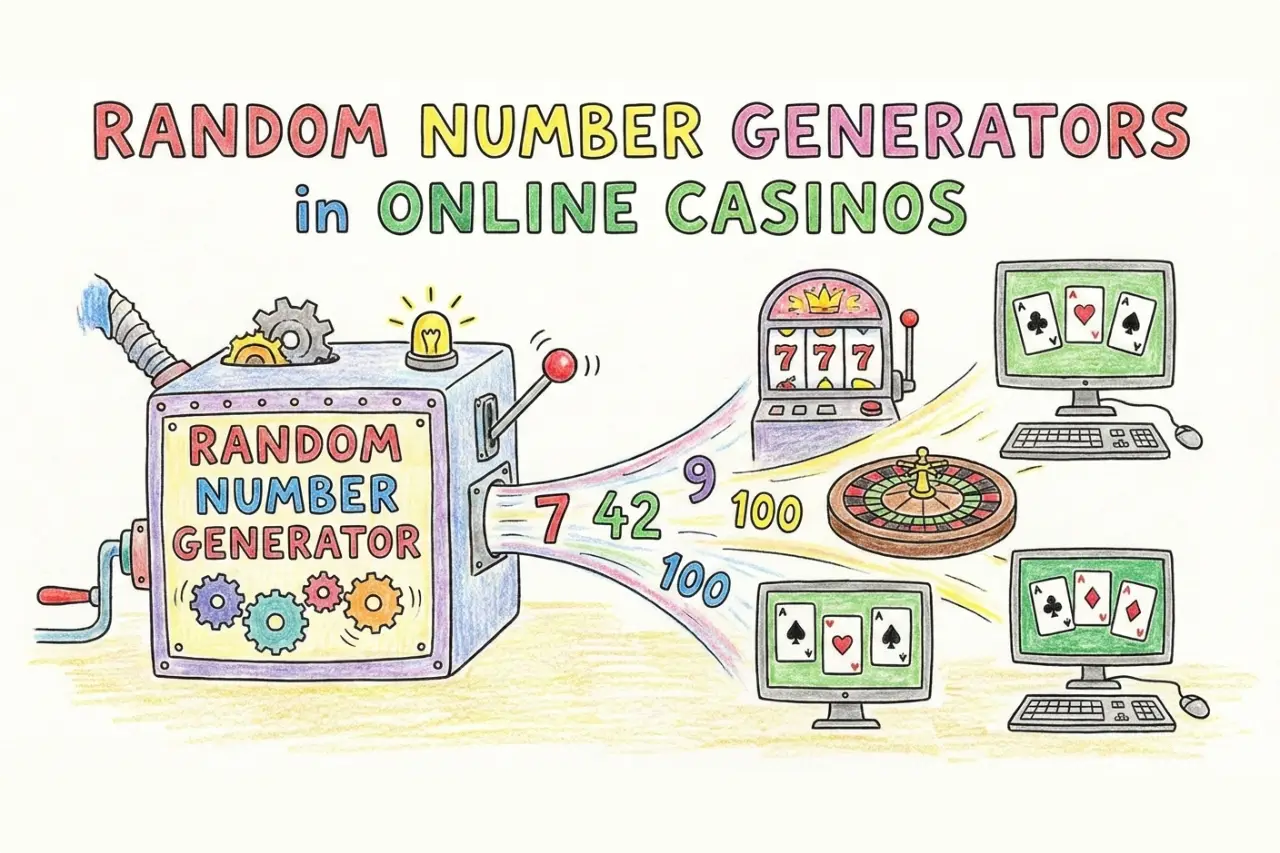
Most players assume slots work like some kind of cosmic balance sheet. Win too much, the game corrects. Lose too much, a payout is coming. It makes intuitive sense. It feels true. And it is completely, mathematically, provably wrong. Once you understand how Random Number Generators actually work, a lot of gambling superstitions evaporate on the spot. This guide breaks down the machinery behind every spin, every card, and every crash point in plain language.
You tap the button. Here’s what happens in roughly three milliseconds, before the reels even start their animation:
That last part is worth repeating: the spinning reels are decoration. Your result was decided before the first reel moved a single pixel. The three-second animation is theatre designed to build suspense. The game already knows whether you won or lost. It’s just making you wait.
Online casinos use something called a Pseudo-Random Number Generator. The word “pseudo” throws people off. It sounds like fake random. It’s not. It’s math-generated random, as opposed to physics-generated random (like rolling dice or measuring radioactive decay). The output is deterministic in theory, meaning if you knew the exact starting conditions, you could reproduce the sequence. But nobody knows the starting conditions, and the sequence is so astronomically long that predicting the next number is effectively impossible.
The workhorse algorithm behind most casino software is the Mersenne Twister, built in 1997 by Makoto Matsumoto and Takuji Nishimura. Two numbers you should know about it:
The algorithm starts from a “seed” value. Think of the seed as the first domino in a chain. Push it, and every subsequent domino falls in a fixed order. Same seed, same sequence, every time. That’s the “pseudo” part. The randomness comes from the seed being unpredictable. Casino systems generate seeds from chaotic sources: server clock timestamps in microseconds, network packet timing, electrical noise from hardware. Some platforms use dedicated physical devices that measure thermal noise to produce seeds. The result is a starting point that nobody, not the casino, not the player, not the game provider, can predict or reproduce.
The RNG doesn’t know what game you’re playing. It has no concept of Zeus, cherries, wilds, or scatter symbols. It just produces numbers. The game software translates those numbers into visual results using a weighted mapping system.
Here’s a stripped-down example. Imagine a single reel with 5 symbol types. The provider assigns each symbol a weight based on how often it should appear:
| Symbol | Weight | RNG Range (out of 100) | Probability |
|---|---|---|---|
| Low-pay symbol (J, Q, K) | 40 | 1-40 | 40% |
| Mid-pay symbol | 30 | 41-70 | 30% |
| High-pay symbol | 18 | 71-88 | 18% |
| Wild | 8 | 89-96 | 8% |
| Scatter / Bonus | 4 | 97-100 | 4% |
The RNG generates 73. That falls in the 71-88 range. High-pay symbol. Done. Now do that for every position on every reel (5 reels with 3 visible rows each = 15 RNG calls per spin on a standard slot), compare the resulting grid against the pay table, and that’s your payout.
A modern slot like Gates of Olympus uses a cluster-pay system instead of reels, so the mapping works differently (each grid cell gets a symbol), but the concept is identical. Sweet Bonanza does the same thing with its tumble mechanic. Number in, symbol out, math determines the rest.
These mapping tables are where the RTP lives. A 96% RTP slot has weights calibrated so that over millions of spins, the payouts add up to 96% of total wagers. Change the weights slightly, and you get a 94% version of the same game. Same graphics, same sounds, different math. This is exactly how providers like Pragmatic Play ship multiple RTP versions of their slots, and why checking the RTP in the game info panel matters (more on that in the highest payout casinos guide).
The core principle never changes: generate random number, map to outcome. But the mapping logic varies a lot depending on what you’re playing.
Slots: Multiple RNG calls per spin (one per reel position). Weighted mapping tables. Variable RTP based on provider configuration. This is the most complex implementation because the math needs to account for paylines, multipliers, bonus triggers, and cascading wins.
Virtual blackjack and baccarat: The RNG shuffles a virtual shoe of cards. Each card position in the deck is randomized, and cards are dealt in sequence. The weights here are equal (every card has the same probability), so the RTP is locked by the rules of the game. A casino can’t secretly make blackjack worse by adjusting the RNG. The math is the math.
Virtual roulette: One RNG call per spin. The number maps to one of 37 positions (European) or 38 (American). Equal probability for each. Again, the casino can’t adjust the odds because the RNG mapping is uniform.
Live dealer: No RNG at all for the game outcome. Real cards, real wheels, real physics. The only RNG involved is in digital bonus segments of game shows like Crazy Time.
Crash games: The RNG determines the crash multiplier. In Aviator, Plinko, and JetX, this happens through a provably fair system using cryptographic hashes instead of traditional PRNG. Which brings us to an entirely different way of doing randomness.
This is a distinction most players don’t know exists, and it matters more than almost anything else on this page.
How it works: The game provider builds the RNG. An independent lab (eCOGRA, iTech Labs, GLI, BMM) tests it by analyzing source code, running millions of simulated rounds, and applying statistical randomness tests (Diehard suite, NIST suite). If the output passes, the game gets a certificate.
Who uses it: Every major provider. Pragmatic Play, NetEnt, Play’n GO, Hacksaw Gaming, Nolimit City.
Your role: Trust. You can’t verify individual results yourself. You’re relying on the lab’s competence and the provider’s license.
Weakness: You have to take someone else’s word for it. If the audit was sloppy, or if the provider changed something after certification, you’d never know.
How it works: Before each round, the casino commits to a server seed by publishing its SHA-256 hash. You set a client seed. A nonce counts your bets. The result is calculated from HMAC-SHA256(server_seed, client_seed:nonce). After the round, you can reveal the server seed, hash it yourself, and verify the casino didn’t tamper with it.
Who uses it: Crypto casinos. Games like Aviator, Plinko, JetX, dice, mines.
Your role: Verify. You can independently recalculate every game result and confirm the casino played fair.
Weakness: Only works for games built on the system. You can’t provably-fair a Pragmatic Play slot because the game logic is closed-source.
Neither system is perfect. Certified RNG has decades of regulatory infrastructure behind it but requires trust. Provably fair is mathematically verifiable but only covers a subset of games. The smartest approach is to play certified games from major providers at licensed casinos, and use provably fair games when you want that extra layer of personal verification.
Five names come up again and again on casino websites, usually as tiny badges in the footer that nobody clicks. But those badges represent months of testing work. Here’s what each lab actually does:
| Lab | HQ | What They Check | Known For |
|---|---|---|---|
| eCOGRA | London, UK | RNG output, RTP verification, player protection policies | Publishing monthly payout reports for casinos |
| iTech Labs | Melbourne, Australia | RNG certification, game math validation, platform testing | Testing the most online casino platforms globally |
| GLI | Lakewood, NJ, USA | Full system audits, RNG, land-based and online | Largest independent testing lab in the industry |
| BMM Testlabs | Las Vegas, NV, USA | RNG, game certification, sports betting systems | One of the oldest labs (since 1981) |
| NMi | Delft, Netherlands | RNG, game certification, regulatory compliance | European regulatory focus, established 1859 |
The testing process involves source code review (reading the actual program), compilation of raw RNG output (running the algorithm millions of times and collecting the numbers), and statistical analysis using test suites like the Diehard battery (developed by George Marsaglia in 1995) and the NIST Statistical Test Suite. These tests check for frequency bias, serial correlation, runs, gaps, and dozens of other properties that would indicate the output isn’t truly random.
One thing most players don’t realize: the certification belongs to the game provider, not the casino. When Pragmatic Play gets their games certified by iTech Labs, that covers every casino running those games. The game logic, including the RNG, runs on Pragmatic’s servers. The casino just relays your bet and displays the result. So if a casino’s lobby is full of NetEnt, Play’n GO, Hacksaw Gaming, and Nolimit City titles, you’re playing on certified RNG regardless of what the casino itself does or doesn’t have audited.
If the casino runs games from established providers: no. They physically can’t. The game software lives on the provider’s servers. The casino sends “player placed a $2 bet on Sweet Bonanza” and the provider’s server sends back “here’s the result.” The casino has no access to the RNG, can’t modify game outcomes, and can’t target specific players. They could shut the game off entirely, but they can’t make it give you worse results.
Could the provider itself cheat? They have the code. But they also have licenses in multiple jurisdictions, multi-million dollar businesses, and independent labs auditing them. The risk-reward math makes it absurd. A company generating billions in licensing fees isn’t going to risk annihilation to skim a few extra points off one slot.
Where it gets genuinely dangerous is unlicensed casinos running homegrown games with no third-party audits. If the software was built in-house and nobody independent has tested it, the randomness is an honor system. That game could have a 96% RTP label on it and actually be running at 85%. You’d never know, because the only people who’ve seen the code are the same people profiting from it.
The casino carries only games from providers you’ve never heard of. No licensing info (or a license that can’t be verified). No testing lab badges. The game info panel hides or omits RTP data. Player forums are full of consistent complaints about games “feeling off.” Any one of these is a yellow flag. Two or more is your cue to leave.
This isn’t theoretical. It happened.
In 2014, a group of Russian operatives figured out the PRNG algorithm used in certain Aristocrat slot machines installed in casinos across the US, Europe, and Macau. The machines used an older, weaker random number generator. The group sent agents into casinos with smartphones hidden in their pockets, recording the outcomes of dozens of consecutive spins. That data was transmitted back to a team in St. Petersburg, where custom software analyzed the results and reconstructed the internal state of the PRNG.
Once they had the state, they could predict when the machine would hit a payout. An agent would stand at the machine, wait for the signal (delivered via a custom app with haptic feedback), and press spin at exactly the right millisecond. The timing window was about 0.025 seconds. They pulled it off repeatedly across multiple countries before casino security and the FBI caught on.
The exploit worked because the machines used an old PRNG with a relatively short period and no re-seeding. Modern online casino RNGs are a different animal: longer periods, stronger algorithms, frequent re-seeding, and the RNG runs server-side where nobody can observe the raw output. The 2014 case is a fascinating story, but it’s not a blueprint for beating current systems. It’s more like a cautionary tale about what happens when you don’t update your security.
When you’re grinding Gates of Olympus waiting for four scatters to land, the RNG is involved in two separate moments. First: does the bonus trigger? The RNG output for each grid position determines whether a scatter lands there. If four or more positions produce scatter symbols, you’re in. Second: everything inside the bonus. Every multiplier bubble, every symbol drop, every respin. All fresh RNG calls, independent of everything that happened before.
The trigger frequency is baked into the game math. A typical high-volatility slot triggers its bonus once every 150 to 300 spins on average. “Average” is doing a lot of work in that sentence. You could trigger two bonuses in 20 spins or go 600 spins dry. Both are normal outcomes under the probability distribution. The RNG isn’t “building up” to a bonus or “cooling down” after one. It’s pulling numbers from the same stream every time, and the scatter symbols either fall in the right positions or they don’t.
What about the buy bonus feature? Slots from Hacksaw Gaming and Pragmatic Play let you pay a fixed amount (typically 100x your bet) to skip straight into the bonus round. Does buying change the RNG behavior inside the bonus? No. The same algorithm generates the same type of random outcomes. The multipliers, the symbol placements, the number of free spins or respins, all determined by fresh RNG calls that don’t care how you got there. The average payout of a bought bonus is calibrated to roughly match the purchase price (slightly below, because house edge), but any individual bonus can range from near-zero to thousands of x.
Players who buy 50 bonuses in a row and track the results sometimes notice streaks of bad results and conclude the feature is “rigged differently.” It’s not. It’s variance. If you flipped a fair coin 50 times, you’d likely see a run of 5 or 6 heads in a row somewhere. Doesn’t mean the coin is weighted. Small sample sizes produce lumpy-looking results. That’s statistics, not conspiracy.
This mix-up happens constantly. “This slot has bad RNG” when they mean “this slot has low RTP.” These are different concepts, and treating them as interchangeable leads to poor decisions.
RNG = the mechanism that makes results random. If it works correctly, every spin is independent and unpredictable. A working RNG is a binary thing: either the game is random, or it’s not.
RTP = the percentage of money the game returns over time. This is a spectrum. A 98% RTP game gives you better long-term value than a 93% game. Both can have perfectly functioning RNGs.
You can have a 92% RTP slot with a flawless, certified RNG. The game is fair in the sense that every result is genuinely random. It’s also taking 8 cents of every dollar you bet. Fair and generous are not the same thing. Understanding this distinction keeps you from blaming “rigged software” when you’re actually just playing a low-payout game.
In 2015, a player’s screen displayed a $42 million jackpot win on a slot machine. The casino refused to pay, citing a software malfunction. The actual jackpot pool was nowhere near that figure. After legal proceedings, the court sided with the casino, pointing to terms-of-service language about software errors voiding displayed results.
Bugs like this are extremely rare in modern online gaming, but they highlight something worth knowing: every casino’s terms include a clause along the lines of “in the event of a software malfunction, all affected bets and payouts are void.” The game provider typically issues a fix quickly and the casino compensates affected players for their original bets. But if you see a screen showing a $50 million win on a slot with a $500,000 max jackpot, don’t start shopping for houses.
Playing at the best online casinos with major providers reduces this risk to near zero. The software goes through extensive QA before launch, and critical bugs get patched within hours. But the fine print exists for a reason, and it’s worth reading once.
You’re not going to beat the RNG. That’s not the point. The point is that understanding how this system works changes your behavior in ways that save you money and frustration.
And maybe the most important thing: you stop blaming the software when you lose. Losing is the expected outcome over time. The house edge guarantees it. The RNG just makes sure the losing (and occasional winning) happens fairly. Once you accept that, gambling becomes what it’s supposed to be: entertainment with a price tag, not a broken machine you need to figure out.
The RNG is the one thing in a casino that’s actually on your side, in a sense. It guarantees that every result is random, that nobody is picking winners and losers, and that the stated odds are the real odds. It doesn’t guarantee you’ll win. Nothing does. But it guarantees that your chances are exactly what the game says they are, and in an industry built on taking your money, that kind of honesty is worth understanding.
Plenty of players blame bad luck, blame “rigged slots,” blame timing, blame everything except the one thing actually responsible: house edge math applied to random outcomes over time. Once the RNG clicks, a lot of frustration goes away. Not because you start winning more, but because you stop expecting the game to behave in ways it was never built to behave. Slots don’t owe you anything after a dry streak. Bonuses don’t “build up.” The software doesn’t know your name.
If you take one thing from this entire page, let it be this: the randomness is real, and the math is against you. Both of those facts can be true at the same time. A fair game can still cost you money, because fair and free are two very different words. Play at reputable casinos with certified providers. Check the RTP in the game info panel. Use provably fair verification when it’s available. Set a budget, stick to it, and treat gambling as entertainment with a price tag. The RNG will do its job. Your job is everything else.
No. The RNG runs server-side. Whether you’re on a phone or laptop, your device just displays results. The randomness is generated on the provider’s server regardless of your device.
No. The random number is generated before your bet amount is considered. A $0.20 spin and a $200 spin get the same random treatment. Bet size changes your payout in money terms, not your probabilities.
The Mersenne Twister (MT19937) is the industry standard. Some newer implementations use Fortuna or other cryptographically secure PRNGs, but the Mersenne Twister remains dominant due to its speed and proven track record.
A system using cryptographic hashes (SHA-256) that lets you verify each game result was generated fairly. The casino commits to a seed before the round. You can check the math after. Common in crypto casinos.
No. The game logic runs on the provider’s server. It receives a bet, processes it through the RNG, returns a result. It has no knowledge of your identity, history, or account balance. Targeting individuals would require provider-level fraud.
Because fair doesn’t mean free. Every game has a house edge. A 96% RTP slot takes 4 cents of every dollar wagered on average. The RNG makes sure this happens randomly rather than predictably, but the math ensures the casino profits over time.

Hi everyone, my name is Kevin and I am an author and creative manager at wagermaniacs.com. I have extensive experience in the field of gambling, as well as more than 15 years of experience playing in online casinos. These two facts allow me to be called a real expert in the field of iGaming.
My favourite online casinos: Vavada, Casino-X, Riobet and Mostbet