
To understand what RTP is I spent six months tracking every spin. Every bet. Every win and loss. I played one slot game religiously, logging results in a spreadsheet, determined to prove whether RTP actually meant anything in practice. After 15,000 spins and $7,500 wagered, my calculated return was 95.8%. The game’s published RTP? 96%. Close enough to be statistically significant. Far enough to prove RTP isn’t perfect, but real enough to matter.
We also recommend that you read:
That experiment taught me more about RTP than any article ever could. But here’s what it didn’t teach me: how RTP is actually calculated. What goes into those percentages. Why games have different RTPs. How providers build this math into games. That’s what this guide covers. The technical stuff. The real mechanics. The math behind the magic.
This isn’t another “RTP is the percentage you get back” article. You already know that. This is the deep dive. How it’s calculated. Why it varies. What affects it. How it’s tested. The stuff providers don’t always explain clearly because most players don’t care. But if you’re reading this, you probably do.
RTP stands for Return to Player. It’s the percentage of all wagered money that a game returns to players over time. If a game has 96% RTP, it means that for every $100 wagered (collectively by all players), the game returns $96. The house keeps $4. That’s the house edge: 4%.
Simple, right? Except it’s not. Because that 96% isn’t guaranteed in any single session. It’s calculated over millions of spins. Your 100-spin session could return 50% or 200%. That’s variance. RTP is the long-term average. The mathematical truth that reveals itself only with massive sample sizes.
The Basic RTP Formula:
RTP = (Total Amount Returned / Total Amount Wagered) × 100%
This is calculated over millions of game rounds, not individual sessions.
The key phrase there: over time. RTP doesn’t apply to your Tuesday night session. It applies to the game’s entire existence. Every spin ever made. Every bet ever placed. Over that totality, the returns converge toward the published RTP. But your individual experience? That’s chaos. Beautiful, frustrating chaos.
Game providers don’t just pick RTP percentages out of thin air. They’re calculated mathematically during game development. Here’s how it actually works:
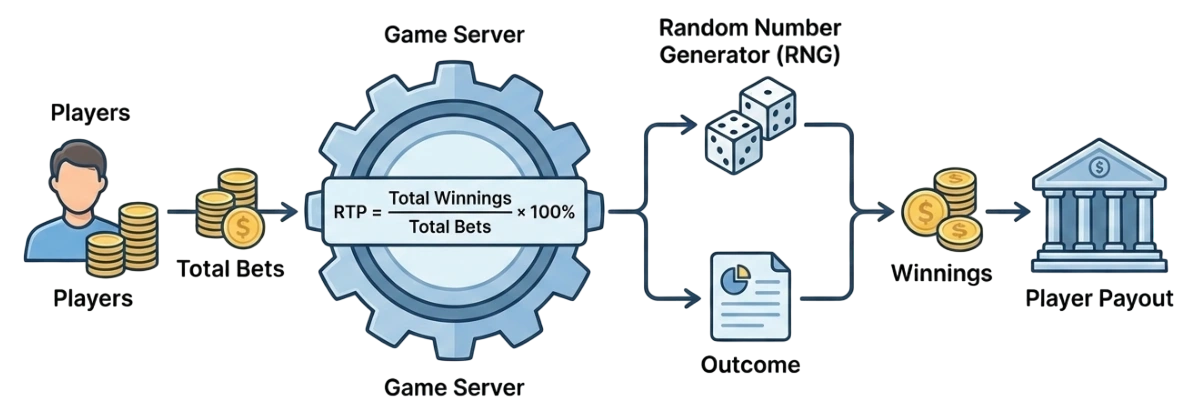
For slot games, RTP starts with the pay table. Each symbol combination has a payout value. Providers determine how frequently each combination appears. More common combinations pay less. Rare combinations pay more. The frequency of each combination, multiplied by its payout, determines the game’s base RTP.
Here’s a simplified example: A slot has five reels with 30 symbols each. One symbol appears on every reel 10% of the time. Hitting five of that symbol pays 100x your bet. The probability of getting five is 0.10 × 0.10 × 0.10 × 0.10 × 0.10 = 0.00001 (0.001%). Expected value: 0.00001 × 100 = 0.001 per spin.
Providers calculate this for every possible combination. They add up all expected values. That sum becomes the game’s theoretical RTP. Then they adjust it through bonus features, free spins, multipliers, and special mechanics.
| Symbol Combination | Probability | Payout Multiplier | Expected Contribution |
|---|---|---|---|
| Five Premium Symbols | 0.00005 (0.005%) | 500x | 0.025 |
| Four Premium Symbols | 0.001 (0.1%) | 50x | 0.05 |
| Three Premium Symbols | 0.02 (2%) | 10x | 0.20 |
| Two Premium Symbols | 0.15 (15%) | 2x | 0.30 |
| No Win | 0.82895 (82.895%) | 0x | 0.00 |
| Total Base RTP | 57.5% (before bonuses) | ||
That table shows base game RTP without bonus features. Modern slots then add free spins, multipliers, bonus rounds, and special mechanics that increase RTP to the final published percentage.
Free spins, bonus rounds, and special features add to RTP. Providers calculate how often these features trigger and what they return on average. A game might trigger free spins 5% of the time, with those free spins returning an average of 40x the triggering bet. That adds 2% to RTP (0.05 × 40 = 2.0).
But it’s more complex than that. Bonus features have their own symbol frequencies and payouts. Providers simulate millions of bonus rounds to calculate average returns. They factor in multipliers, retriggers, expanding wilds, and any feature that affects payouts. All of this gets added to base game RTP.
The RNG determines which symbols appear. It’s not truly random (computers can’t generate true randomness), but it’s cryptographically secure pseudo-random. This means patterns are unpredictable for practical purposes, even though the sequence is technically deterministic.
Testing labs verify RNG randomness. They run statistical tests checking for patterns, biases, or predictability. If the RNG isn’t properly random, results won’t match theoretical RTP. That’s why independent testing is crucial. Providers can’t just calculate RTP and call it done. They need third-party verification that actual game results match calculations.
I’ve seen games fail RNG testing. Usually it’s not malicious. It’s coding errors. The RNG might have slight biases that only appear over millions of spins. Testing labs catch these. Providers fix them. Games get recertified. The system works, but only if games are actually tested.
After calculating theoretical RTP, providers run simulations. Millions of spins. Billions sometimes. They track actual returns and compare them to theoretical calculations. If results don’t match (within acceptable statistical variance), they investigate. Usually they find calculation errors or RNG issues.
Simulation Process (Simplified): For each spin (1 to 10,000,000): – Generate random number from RNG – Determine reel positions based on RNG output – Calculate win based on symbol combinations – Add win to total returns Total Returns = Sum of all wins Total Wagered = Number of spins × Bet per spin Actual RTP = (Total Returns / Total Wagered) × 100% Compare Actual RTP to Theoretical RTP If difference > acceptable variance threshold: – Review calculations – Check RNG quality – Fix issues – Re-run simulation
These simulations run for days sometimes. Providers need statistical confidence that actual results match calculations. A 96% theoretical RTP game that actually returns 95.8% over 10 million spins is within acceptable variance. One that returns 94% is not. Something’s wrong. It gets fixed.
RTP isn’t fixed for all games. Multiple factors determine the final percentage:
Many games have different RTP versions based on bet size. Lower bets might get 94% RTP. Higher bets unlock 96% or 98% RTP. Same game. Same mechanics. Different math. Providers calculate RTP for each bet level configuration separately.
This isn’t about fairness. It’s about player segmentation. High rollers get better RTP to encourage larger bets and longer sessions. Casual players get lower RTP because they’re less likely to notice or care. Both versions are tested and certified. Both are legitimate. But they’re different.
| Bet Level | RTP Configuration | Symbol Frequency Adjustments | Bonus Trigger Adjustments |
|---|---|---|---|
| $0.10 – $0.99 | 94.0% | Lower frequency of high-paying combinations | Standard trigger rates |
| $1.00 – $4.99 | 95.5% | Medium frequency adjustments | Slightly improved trigger rates |
| $5.00+ | 96.5% | Higher frequency of high-paying combinations | Improved bonus trigger rates |
Slots calculate RTP through symbol frequencies, payout tables, and bonus features. The math is probabilistic. Outcomes are determined by RNG. No skill involved. RTP is fixed based on game design. Players can’t improve it through strategy.
Slot RTP typically ranges from 92% to 98%. Most modern slots are 94-96%. Classic slots sometimes hit 98%+ because they have simpler mechanics without complex bonus features that add variance. If you’re looking for slots with good RTP values, check out different slots from best providers:
Table games calculate RTP based on game rules and optimal play. Blackjack with perfect basic strategy is 99.5% RTP. That’s fixed by rules. But most players don’t play perfectly, so their actual RTP is lower. The game’s maximum RTP is 99.5%, but individual player RTP varies based on skill.
European Roulette is always 97.3% RTP regardless of how you play. Rules are fixed. The math is fixed. You can’t improve it or make it worse through strategy. But you can make it worse through terrible bet selection (like the five-number bet in American roulette, which drops RTP to around 92%).
| Game Type | RTP Calculation Method | Typical RTP Range | Skill Impact |
|---|---|---|---|
| Slot Games | Symbol frequency × Payouts + Bonus features | 92-98% | None (RTP is fixed) |
| Blackjack | Game rules + Optimal strategy probability | 95-99.5% | High (strategy affects RTP significantly) |
| Roulette | Fixed by rules (36 numbers + 0 or 00) | 94.74-97.3% | None (but bet selection can lower it) |
| Baccarat | Fixed by rules (Banker commission structure) | 98.94% (Banker bet) | None (rules are fixed) |
| Video Poker | Hand probability × Optimal strategy | 95-99.5%+ | High (perfect strategy required for max RTP) |
| Live Dealer Games | Same as table games (physical equipment) | 94.74-99.5% | Same as table game equivalent |
Game providers calculate RTP, but independent testing labs verify those calculations. This is crucial because providers have financial incentive to publish higher RTPs (attracts players) while actually offering lower-RTP versions (increases profit). Testing labs catch discrepancies.
Testing labs like eCOGRA, iTech Labs, and GLI run extensive tests. When choosing a casino, look for games from providers we’ve reviewed at WagerManiacs:
Certified games have been independently verified. Their RTPs are accurate. RNGs are fair. Their payouts match advertised values. Non-certified games might have errors, biases, or inaccuracies. Always prefer casinos offering certified games, especially in regulated markets where certification is required by law.
Testing is thorough, but not perfect. It can’t catch:
This is why transparency matters. Good casinos publish RTP clearly. They make it easy to find. They don’t hide low-RTP versions behind confusing descriptions. Trust comes from transparency, not just certification. When choosing where to play, check our best online casinos that prioritize RTP transparency.
RTP tells you the long-term average return. Variance tells you how much results will fluctuate around that average. A game with 96% RTP and high variance might lose 80% of your bankroll one session, then return 200% the next. Mathematically, it still averages 96%. But your experience feels nothing like 96%.
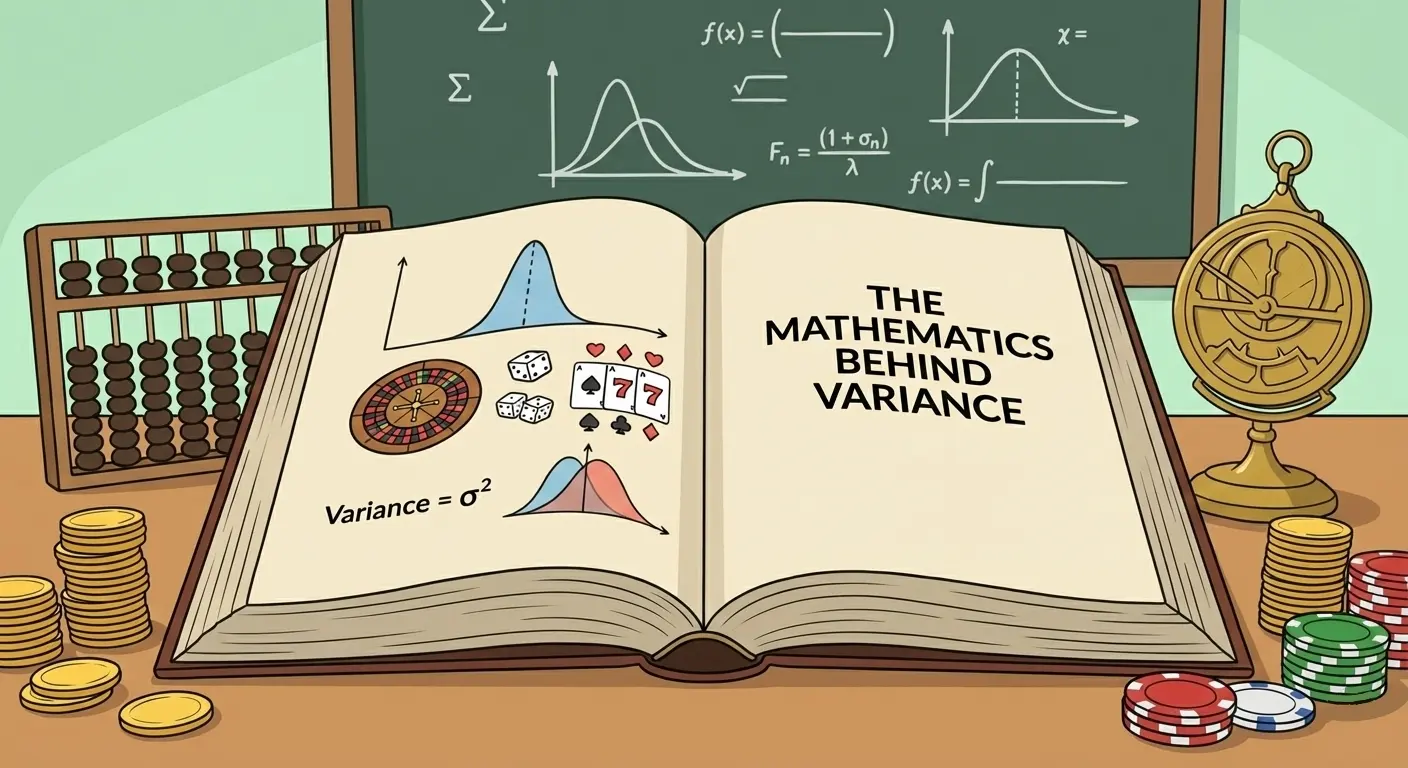
High variance means big swings. Low variance means steadier results. Same RTP, different experiences. Providers design variance intentionally. High-variance games feel more exciting (big wins, big losses). Low-variance games feel steadier (smaller, more frequent wins).
| RTP | Low Variance | Medium Variance | High Variance |
|---|---|---|---|
| 96% | More frequent small wins, steady losses | Mixed win sizes, moderate swings | Infrequent large wins, long dry spells |
| 94% | Very steady, predictable losses | Consistent small losses, occasional wins | Extreme swings, big losses, rare big wins |
| 98% | Very steady small wins | Regular wins with minor losses | Long dry spells, sudden massive wins |
Understanding variance matters more than most players realize. A 98% RTP game with terrible variance might be less enjoyable than a 96% RTP game with good variance. The math favors 98%, but your actual experience might favor 96%.
RTP requires massive sample sizes to become apparent. Here’s why:
Statistical confidence requires sufficient data. For a 96% RTP game, you need thousands of spins before results start converging toward 96%. After 100 spins, your actual return might be anywhere from 70% to 130%. After 1,000 spins, maybe 88% to 104%. 10,000 spins, probably 93% to 99%. After 100,000 spins, likely 95% to 97%.
| Number of Spins | Expected Range (96% RTP Game) | Statistical Confidence | Real-World Interpretation |
|---|---|---|---|
| 100 | 70% – 130% | Very low | Results are essentially random, RTP irrelevant |
| 1,000 | 88% – 104% | Low | Some convergence, but still very unreliable |
| 10,000 | 93% – 99% | Moderate | RTP becoming apparent, but variance still significant |
| 100,000 | 95% – 97% | High | RTP clearly evident, minor variance |
| 1,000,000+ | 95.5% – 96.5% | Very high | RTP fully apparent, minimal variance |
This is why RTP feels meaningless for casual players. You might play 500 spins total. Your results will vary wildly from RTP. You might win big on a 94% RTP game and lose big on a 98% RTP game. That’s normal. RTP only matters over massive sample sizes most players never reach.
Most players will never play enough spins to see RTP actually materialize. You might play 1,000 spins in your entire lifetime on a specific game. That’s nowhere near enough. RTP is calculated over millions of spins. Your individual experience will almost certainly differ from RTP. Don’t judge game quality by single-session results. Variance dominates short-term outcomes. RTP only wins long-term, and most players never reach “long-term.”
Providers don’t just calculate RTP once and call it done. They adjust it during development to hit target percentages. Here’s how:
Changing how often symbols appear directly affects RTP. Make high-paying symbols appear 0.1% less frequently, RTP drops. Make them appear 0.1% more frequently, RTP increases. Providers fine-tune these frequencies to hit specific RTP targets (like 94%, 96%, or 96.5%).
Adjusting payout values changes RTP without affecting symbol frequencies. A combination that pays 100x could pay 95x to reduce RTP, or 105x to increase it. Same frequency. Different math. Providers use this for fine-tuning RTP to exact percentages.
Bonus features are major RTP drivers. Changing how often they trigger, or what they pay on average, significantly impacts RTP. Make free spins trigger 5% instead of 4%, RTP increases. Make them return 20x instead of 25x, RTP decreases. Providers adjust these parameters to balance RTP with player excitement.
Providers can adjust variance (volatility) independently of RTP. A game might have 96% RTP with low variance or 96% RTP with high variance. Same math. Different experience. They do this by changing payout distributions. More small wins = lower variance. Fewer big wins = lower variance. More big wins, fewer small wins = higher variance.
RTP is calculated through complex mathematical modeling. Symbol frequencies, payout tables, bonus features, and game mechanics all factor into the final percentage. Providers spend months developing and testing games to ensure RTP matches calculations. Independent labs verify those calculations through extensive testing.
But RTP isn’t simple. It varies by bet size, jurisdiction, and game version and requires massive sample sizes to become apparent. It doesn’t guarantee individual session results. Variance dominates short-term outcomes. RTP only wins long-term, and most players never reach “long-term.”
Understanding how RTP is calculated helps you make informed choices. It helps you understand why games have different RTPs. It helps you recognize when casinos are transparent versus when they’re hiding information. It helps you find games that offer better mathematical value.
But remember: RTP is one factor among many. Variance matters. Entertainment value matters. Personal preference matters. Don’t sacrifice all enjoyment for percentage points. Find balance. Play games you enjoy, but prefer those with better RTPs when choices exist. Use RTP to improve your odds, not to guarantee outcomes. The math helps, but it doesn’t eliminate house edge or variance. It just makes them more favorable when you choose wisely.
RTP is calculated by determining the probability of every possible outcome, multiplying each by its payout, then summing everything. For slots, this includes symbol combinations, bonus features, free spins, and special mechanics. Providers run simulations of millions of spins to verify calculations match theoretical math. The formula is: RTP = (Sum of all expected values / Total wagered) × 100%.
No. RTP is coded into games during development. Once a game session starts, RTP is fixed. Casinos can choose which RTP version to offer (games often have 94%, 96%, or 98% versions), but they can’t change it in real-time based on your play or results. RTP is determined by game code, not by player outcomes.
RTP requires massive sample sizes. After 100 spins, results are essentially random (might return 70% or 130% even on a 96% RTP game). 1,000 spins, variance is still huge (88% to 104%). After 10,000 spins, RTP starts showing (93% to 99%). 100,000 spins, RTP is clearly apparent (95% to 97%). Most players never reach these numbers, so their individual results will almost certainly differ from RTP.
RTP is the long-term average return percentage. Variance (volatility) is how much results fluctuate around that average. A 96% RTP game with high variance might lose 80% one session, return 200% the next, but average 96% over millions of spins. A 96% RTP game with low variance has steadier, more predictable results. Same RTP, completely different experience.
Very accurate for certified games. Independent testing labs verify RTP calculations through millions of simulations. Certified games must match published RTP within strict statistical variance limits. However, games often have multiple RTP versions (different bet levels, different jurisdictions), and casinos might not always clearly advertise which version you’re getting. The published RTP is accurate for the specific version, but verify you’re playing that version.
Games fail certification. Providers must investigate and fix issues. Usually it’s calculation errors or RNG quality problems. They recalculate, fix code, re-run simulations, then resubmit for testing. Games can’t operate in regulated markets without passing certification. The system works, but only if games are actually tested by legitimate labs.

Hi everyone, my name is Kevin and I am an author and creative manager at wagermaniacs.com. I have extensive experience in the field of gambling, as well as more than 15 years of experience playing in online casinos. These two facts allow me to be called a real expert in the field of iGaming.
My favourite online casinos: Vavada, Casino-X, Riobet and Mostbet