
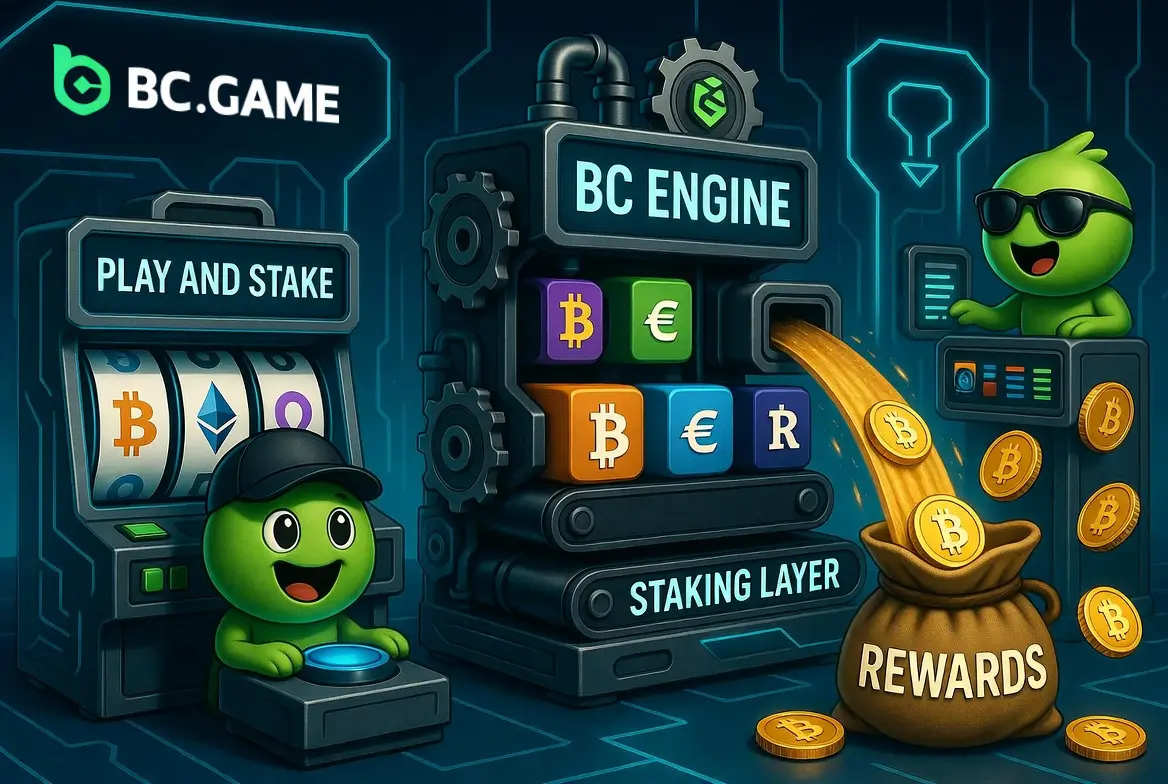
BC.GAME, the Curaçao-licensed crypto casino that’s been quietly elbowing its way into the same conversation as Stake and Rollbit for the past two years, just rolled out something none of its competitors are doing: a staking-style rewards layer welded directly to the casino’s loyalty program. They’re calling it the BC Engine. The launch was confirmed in an April 8, 2026 press release, and players started seeing the new dashboard live in their accounts the same week.
The pitch is simple enough to fit on a slide. You play, you earn $BC tokens. The tokens automatically flow into the BC Engine. The Engine pays you out, every hour, in BCD — the platform’s USD-pegged stablecoin. The longer you hold, the more you compound. There’s no minimum balance, no VIP tier requirement, and no manual claim-and-restake routine to forget about on a Sunday morning.
For a sector where “loyalty program” usually means a cashback percentage and a free spin on your birthday, this is a genuine swerve.
What the BC Engine Actually Does
Strip away the marketing language and the system has three moving parts:
- $BC accrual. Every wager you place, on slots, sports, or live tables, generates $BC tokens. The accrual rate scales with stake size and game contribution, the way a normal points system would.
- Auto-allocation into the Engine. Whatever $BC you’ve earned drops into the BC Engine pool by default. There’s no separate staking step. You don’t sign a transaction. You don’t move anything to a wallet. The platform treats the Engine balance as a custodial position inside your casino account.
- Hourly BCD distributions. Once an hour, the Engine pays out a yield in BCD, BC.GAME’s USD-pegged in-house stablecoin. The size of your slice is proportional to your share of the total $BC pool — meaning the more $BC the platform issues into circulation, the more your hourly cut dilutes, and vice versa. Holders who play regularly therefore have two independent reasons to keep accruing tokens.
The hourly cadence is the part that most directly mimics DeFi staking, where rewards typically distribute by block or by epoch and compound automatically inside the wallet. BC.GAME isn’t running a real on-chain protocol here — the entire mechanism lives inside their server-side accounting — but the user-facing experience is built to feel like it does. BTC Gambling’s coverage describes it as “the first time a major casino has made loyalty look indistinguishable from yield farming,” which is overheated but not entirely wrong.
Why This Is Different From the Standard Casino Loyalty Loop
Most casino loyalty programs trap value at the bottom. You play, you earn points, the points expire if you go inactive, and the conversion rate from points to cash is usually atrocious. Some platforms, BC.GAME’s biggest competitor included, have moved partway toward dynamic models — Stake’s Tier system, for instance, shifts your rakeback rate based on lifetime wager. But the basic transaction is still the same: spend more, get a slightly bigger slice back.
The Engine flips that. Once $BC is in your pool, you keep earning on it whether you play or not. Hold for a week without depositing again, and the BCD still drips in every hour. That changes what a loyalty balance even is. It stops being a one-time discount on future play and starts behaving like a yield-bearing asset that happens to live inside a casino.
The risk side is real, of course. BCD is BC.GAME’s own stablecoin, not an externally audited one like USDC or USDT. The peg holds because BC.GAME backs it, period. If the platform takes a hit — regulatory, financial, or otherwise — the redemption mechanics are governed by their terms of service, not by any protocol. The same goes for the $BC token, which is issued, distributed, and ultimately burned at the platform’s discretion. None of this is on a public chain that you can independently verify.
Sophisticated crypto players will recognize this immediately for what it is: centralized yield, dressed in DeFi clothing. That’s not necessarily bad. It just means you’re trusting BC.GAME the same way you’d trust any custodial exchange, with extra steps.
The Other 2026 Upgrades
BC Engine didn’t ship alone. The April 2026 update bundle includes:
- Welcome Shield. A 72-hour protection window for new accounts that automatically refunds 20% of net losses up to a capped amount. Aimed at first-time players who blow through their first deposit too aggressively. Activates by default.
- Daily, weekly, and monthly recurring rewards. Familiar territory for anyone who’s used a casino loyalty program before, but the rewards now route through the Engine, meaning even the basic cashback flows compound while sitting in your account.
- VIP rebuild. The previous VIP system has been overhauled with a “lifetime status” guarantee — once you hit a tier, you don’t lose it from inactivity. That’s a significant departure from the industry-standard rolling-window model where high rollers have to keep wagering monthly to maintain perks.
- Transparent XP curve. The internal points system has been recalibrated to match real game costs, fixing one of the long-running complaints about earlier versions of BC.GAME’s loyalty math, where high-RTP slots and table games barely moved the needle.
The platform also relaunched its public branding the same week — new logo, new wordmark, and the phrase “Stay Untamed” stamped across most of the marketing surface. It’s the first major visual identity change since the platform’s 2017 founding under a quiet rollout flagged by iGaming News.
The Numbers Behind the Platform
For context on why any of this is worth paying attention to: BC.GAME currently lists more than 8,000 games across slots, live dealer, sports, and esports, supports over 150 cryptocurrencies for deposits and withdrawals, and ranks consistently inside the top three crypto casinos by traffic. The April 2026 update follows a string of awards through late 2025 and early 2026, including a “Top Crypto Casino” nod at the SiGMA Eurasia event.
That’s the surface-level brag. The more important number, for anyone trying to figure out whether the Engine is a sustainable mechanic or a six-month marketing stunt, is BC.GAME’s reported gross gaming revenue trajectory. The platform hasn’t published 2025 GGR publicly — it’s privately held and not obligated to — but third-party traffic estimates show the platform doubling visitor counts year-on-year through Q1 2026. Stake and Rollbit are still bigger by handle, but the gap has been closing for four straight quarters, and the BC Engine is being framed internally as the lever that closes it further.
The honest read is that BC.GAME is throwing yield at the customer-acquisition problem the same way DeFi protocols did during the 2020-2021 cycle. It worked then, until it didn’t. Whether it works for a casino — where the underlying business is a known-margin operation, not an experimental token — is the question that 2026 will answer.
How It Stacks Up Against the Competition
The comparable references are not other casinos. They’re the on-chain staking protocols and the centralized exchanges that pioneered “earn” products. Coinbase Earn, Binance Simple Earn, Kraken Staking — those are the products the BC Engine actually resembles, repackaged for a casino audience.
Inside the gambling sector, the closest peer is Rollbit’s RLB token, which uses a buyback-and-burn model funded by casino revenue rather than a per-user yield distribution. Stake doesn’t have a public token at all. Gamdom and BetFury have toyed with stablecoin rebates and revenue-share schemes but at smaller scale and without the hourly cadence. So if you’re already covering this market in any depth, the BC Engine fills a gap the rest of the field has been circling for years without committing.
For players choosing where to put their crypto bankroll, the relevant question is whether the projected hourly yield, compounded over a typical play volume, materially beats the rakeback you’d get at a conventional casino. Early simulations from BC.GAME’s launch dashboard suggest yes — at moderate stake levels, the combined Engine yield plus base cashback produces an effective return of around 3–5% above the platform’s nominal rakeback. That’s not life-changing money on small bankrolls, but it’s enough to matter on six-figure annual wager volumes, which is the population BC.GAME is clearly courting.
If you’re new to crypto-native gambling generally, our deep-dive on the best crypto casinos is the right starting point before opening an Engine position. And if you want to skim the platform itself first, our BC.GAME review covers the licensing, withdrawal speed, and game-library specifics in detail.
The Founder Context: Ed Craven Is Watching
One of the underdiscussed angles here is competitive. Ed Craven, the co-founder of Stake, has built the world’s largest crypto casino on the back of streamer-driven brand awareness, sports sponsorships, and aggressive rakeback. The BC Engine is a direct strike at the third pillar — it offers a tangible economic reason to consolidate your crypto play on BC.GAME instead of spreading it across the field. Whether Stake responds with its own staking-flavored product, or counter-punches with bigger sponsorship deals instead, will be one of the more interesting subplots of late 2026.
The other founder worth thinking about, by way of contrast, is Isai Scheinberg of PokerStars. Scheinberg built a multi-billion-dollar gaming company with effectively zero loyalty-token engineering — just product, payment reliability, and player trust. Two decades later, the casino industry is testing whether tokenomics can compress that kind of brand-building into a marketing budget cycle. BC Engine is a real-world stress test.
Risks and What to Watch
A few things genuinely worth flagging if you’re considering parking $BC inside the Engine:
- Custody risk. Your $BC and BCD live on BC.GAME’s books, not on a public chain. If the platform faces enforcement action in a major market — and crypto casinos are firmly in the regulatory crosshairs in 2026 — withdrawal access can be slowed or restricted unilaterally. We’ve covered enforcement waves in Sweden and the Netherlands in detail. The risk is not theoretical.
- Tokenomic dilution. The hourly distribution is divided across the total $BC pool. If BC.GAME ramps up token issuance to acquire new players, your effective yield drops even if your balance stays flat. There’s no public emission schedule.
- Regulatory framing. A staking-style yield product attached to a gambling account sits in an unusual place legally. Some regulators will treat it as a form of unregistered investment offering; others won’t notice. Expect at least one major jurisdiction to ask hard questions before the year is out.
- Withdrawal liquidity. BCD redemption assumes the platform has the reserve to honor it on demand. In stable conditions, that’s fine. Under stress, “stable” stablecoins can wobble, especially the ones whose backing isn’t independently audited.
None of this means the BC Engine is a bad product. It means it’s a new product, and players treating it like a savings account are mispricing it. The right framing is: this is a casino loyalty program with a yield curve, run by a private company on Curaçao licensing, that you should size accordingly.
The Bigger Pattern
2026 has been the year crypto-native casinos stopped imitating Las Vegas and started imitating DeFi. The BC Engine isn’t an isolated experiment — it’s the most polished version of a trend that’s been building for 18 months. Expect competitors to ship copycat products through the back half of the year, and expect the market for “casino-as-yield” mechanics to fragment quickly.
Whether players come out ahead depends entirely on the discipline of the operators running these systems. A loyalty program that pays 3-5% above baseline rakeback, sustained, is genuinely valuable. The same program with a token that quietly inflates 50% over six months is just an expensive way to lose money slower. The next four quarters will sort the difference.
Sources

Hi everyone, my name is Kevin and I am an author and creative manager at wagermaniacs.com. I have extensive experience in the field of gambling, as well as more than 15 years of experience playing in online casinos. These two facts allow me to be called a real expert in the field of iGaming.
My favourite online casinos: Vavada, Casino-X, Riobet and Mostbet