
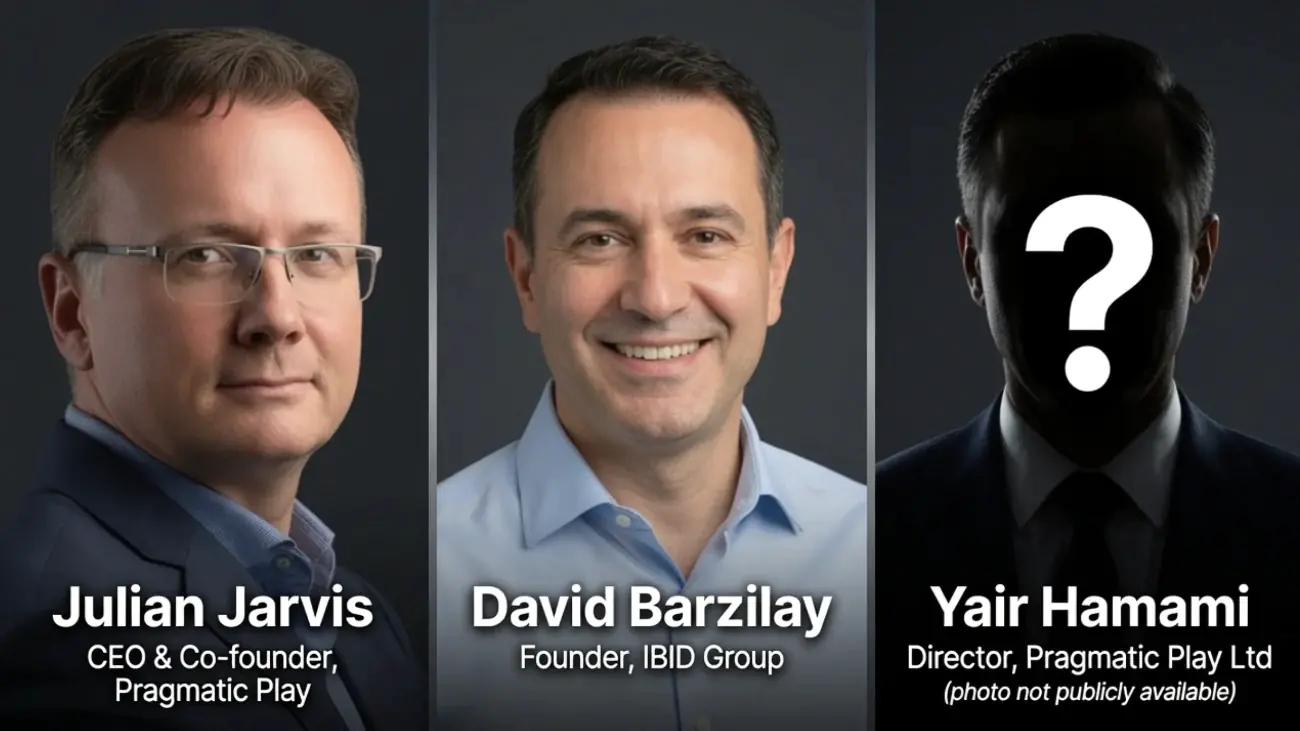
Here is the strange thing about the biggest slot studio in the world. You can probably name a dozen of its games off the top of your head. Gates of Olympus. Sweet Bonanza. The Dog House. But try to name the person who owns it and you hit a wall almost straight away. There is a public face, polished and lawyerly, and there is a paper trail that a handful of stubborn watchdog sites have spent years pulling apart.
This article walks through both. Who runs Pragmatic Play today, who is credited as its co-founder, and why the company’s early years still get dragged up in forums whenever the brand comes up. I have tried to keep the confirmed facts separate from the allegations, because the two get blended together far too often, and the difference matters.
The short version
Pragmatic Play launched in 2015. Its public leader and credited co-founder is Julian Jarvis, a lawyer by training who also heads the investment company that owns the studio, Veridian (Gibraltar) Limited. That much is on the record and repeated by the company itself.
The complicated part is where Pragmatic Play came from. Its game library and much of its early staff trace directly back to a US-facing provider called TopGame Technology, a name with a genuinely bad reputation. Pragmatic Play says it bought some assets from a defunct company and moved on. Several long-running player-protection sites say the two businesses were closer than a simple asset sale, and they point at specific people to make the case. We will get to all of them.
The face of the company: Julian Jarvis
If Pragmatic Play has a public owner, it is Julian Jarvis. He is described, by the company and across industry coverage, as the co-founder and chief executive. He arrived in 2016 as the group’s Chief Legal Officer and stepped up to CEO in early 2020, so his fingerprints are on nearly the entire journey from scrappy newcomer to market leader.
Jarvis is not a game designer or a maths modeller. He is a lawyer and investor who worked at the gaming technology firm Odobo before this chapter, and that background shows. Pragmatic Play’s whole strategy over the last decade has been a licensing land grab: get certified in as many regulated markets as possible, as fast as possible. That is the move of a company run by someone who reads regulations for a living.
He also sits on both sides of the table. Jarvis leads Veridian, the company that owns Pragmatic Play, and he runs Pragmatic Play itself. Owner and operator, wearing both hats. That is not unusual in privately held iGaming, but it does mean the “ownership” and the “management” of the business point back to the same office.
On the record
Pragmatic Play describes itself as owned by a private group of investors led by Veridian (Gibraltar) Limited, which is headed by Julian Jarvis. The company is private, not listed on any stock exchange, and the exact split of shares is not published.
Veridian, IBID and the ownership trail
Follow the corporate ownership and you land on a couple of holding companies rather than a single named billionaire. The current stated owner is Veridian (Gibraltar) Limited, a Gibraltar investment and development firm. Its stated purpose is to buy and grow digital and iGaming businesses, and it names Pragmatic Play as its headline asset.
Rewind to the middle of the last decade and a different name comes up: the IBID Group. In July 2016 IBID acquired Pragmatic Play, and over the following months it also picked up related businesses, the payments firm Dalberry Technologies and the platform business that became Pragmatic Solutions. Reporting on the company’s history credits Julian Jarvis as a co-founder of IBID as well, which is why the same person keeps appearing at every layer.
So the tidy version reads like this. TopGame’s assets become Pragmatic Play in 2015. IBID Group consolidates Pragmatic Play and its sister companies across 2016 and 2017. Today the ownership is described through Veridian, with Jarvis at the top. Private company, private shareholders, undisclosed stakes. Nothing about that structure is illegal or even rare. It is simply built so that you cannot see all the way to the bottom.
Where it actually started: TopGame Technology
You cannot tell the ownership story honestly without TopGame, because that is the part the official biography tends to skip.
TopGame Technology was a casino software provider that ran from roughly 2007 to 2015, supplying games mostly to casinos serving the United States during the grey years after 2006. Its reputation among players and watchdogs was poor, and not for one single reason. The complaints stacked up: games whose fairness was questioned, casinos on its software that set tiny withdrawal limits, terms and conditions that seemed designed to make cashing out as painful as possible, and marketing that overstated how much people were winning.
Then there is the detail that still gets brought up more than any other. TopGame ran progressive jackpots on games like Bingo Slot, Monster Madness and Stars and Stripes. According to Casino Listings, one of the oldest player-advocacy databases, those seven-figure pools were never won, and when the games moved over to the new Pragmatic Play branding, the accumulated jackpot money did not follow. It was not paid out, not carried forward to new games, and not refunded to the players who had funded it. That, more than the glitches, is why some veterans still refuse to touch the brand.
In 2015 the whole thing was reorganised. TopGame’s games and casino clients were re-flagged under new banners, primarily Pragmatic Play, with some titles landing at other labels like Octopus Gaming and IGTech. Pragmatic Play’s position is that it simply purchased a library of assets from a company that had already failed. Whether that counts as a fresh start or a rebrand is the argument that has never really been settled.
The disputed names: Barzilay and Hamami
This is the section to read carefully, because here we cross from documented company history into claims made by third parties. I am going to attribute each one rather than state it as settled fact, and you should treat it that way too.
What the watchdogs allege
According to Casino Listings, the person tying TopGame and Pragmatic Play together is David Barzilay. The site has stated that both companies were owned by the same man and that Barzilay appeared on the IBID Group’s own website as its founder and managing partner, a listing it says was removed after the connection was published.
The second name is Yair Hamami, described as a senior TopGame figure who reportedly acquired TopGame in 2014 and then moved into a role at Pragmatic Play. Documents that surfaced in the 2017 Paradise Papers leak reportedly identify Hamami as a director and legal representative of Pragmatic Play, and list a company connected to him, TG Solutions Ltd, among Pragmatic Play’s shareholders.
Put those claims together and you get the watchdog thesis in a sentence: the people running Pragmatic Play in its early days were, to a meaningful degree, the same people who ran TopGame, which would make 2015 more of a name change than a clean break. Several casino affiliate sites of good standing have echoed versions of this over the years.
Pragmatic Play has consistently rejected that framing. Its line has always been that it acquired or licensed a games catalogue from a defunct provider and has operated as its own regulated business ever since. Both things can be partly true at once, which is exactly why the debate refuses to die. The company points forward to its licences and its conduct since 2015. The critics point backward to the names on old documents. Neither side has produced a knockout blow in public.
A note on fairness, because it matters. Whatever you make of the origin story, the practical question for a player is whether the games are straight today. Pragmatic Play now holds certifications in heavily regulated markets, and its titles are tested by independent labs before they go live in those jurisdictions. The controversy is about history and ownership transparency, not about a proven rigged game in the licensed present. Keep those two questions separate.
How a controversial startup became the market leader
Set the backstory aside for a moment, because the second half of this story is just as important to who “owns” the brand in practice. Whoever the shareholders are, the thing they own turned into a monster.
Pragmatic Play grew from a 2015 rebrand into the most widely distributed content supplier in online gaming. It went multi-vertical, well beyond slots: live casino, bingo, virtual sports, a sportsbook, scratch cards and crash-style games all sit under the same roof now, delivered to operators worldwide through a single integration. The company is headquartered in Gibraltar with offices spread across Malta, the UK, Romania, Ukraine, India and the Philippines, plus a heavy push into Latin America.
The engine behind that reach is volume. Pragmatic Play releases new slots at a pace few rivals can match, several titles a month, every month. Pair that with aggressive marketing, the recurring Drops & Wins prize campaigns and a genuine hit-making streak, and you get a studio whose logo you cannot avoid. It has been collecting industry hardware to match, including a Casino Supplier of the Year award in 2025.
The legal-first instinct of Jarvis runs right through this. Rivals sometimes chase the highest theoretical payout percentages. Pragmatic Play chased licences and distribution, betting that being everywhere legally beats being marginally more generous. On the numbers, the studio’s slots tend to average a shade under 96.5 percent RTP across the catalogue, with its Big Bass series sitting at the top of its own range. Respectable, rarely class-leading, and clearly a deliberate choice.
The games that actually built the empire
The ownership may be opaque, but the products are not. A short run of releases did most of the heavy lifting, and it is worth knowing which ones, because those hits are what handed the owners the muscle to expand the way they did.
The breakthrough was the tumbling, pay-anywhere format the studio made its own. Gates of Olympus was the one that stuck, so completely that its Greek-gods theme turned into a franchise the company still keeps mining. Sweet Bonanza pulled the same trick with a candy skin and became a streamer favourite, and The Dog House grew into a whole family of sequels. After that it was mostly volume: westerns, fishing slots, Megaways remakes, a new title every week or two. If you want the specifics, the RTP and the features title by title, that is what our Pragmatic Play slot reviews are for.
A quick timeline
| Period | What happened |
|---|---|
| 2007 to 2015 | TopGame Technology supplies games, mainly to US-facing casinos, and builds a poor reputation among players and watchdogs. |
| 2014 | Yair Hamami reportedly acquires TopGame, according to leaked-document reporting. |
| 2015 | Pragmatic Play launches, built on assets and staff traced to TopGame. Some titles also move to other labels. |
| 2016 | IBID Group acquires Pragmatic Play. Julian Jarvis joins as Chief Legal Officer. |
| 2016 to 2017 | IBID consolidates sister companies. The 2017 Paradise Papers leak reportedly names figures linked to both TopGame and Pragmatic Play. |
| 2020 | Julian Jarvis becomes CEO. |
| 2015 to today | Ownership is described through Veridian (Gibraltar) Limited. The studio grows into the most distributed content supplier in iGaming. |
So who owns Pragmatic Play, in one honest paragraph
Officially, Pragmatic Play is owned by a private investor group led by Veridian (Gibraltar) Limited and run by its co-founder and CEO Julian Jarvis, with an early consolidation under the IBID Group and a shareholder list that is not public. Unofficially, and according to established player-protection sites rather than the company, its roots and some of its early principals reach back into TopGame Technology, with the names David Barzilay and Yair Hamami repeatedly attached to that link. The company owns the first version of that story. It has never accepted the second.
Frequently asked questions
Julian Jarvis is publicly credited as the co-founder and is the current CEO. The company’s games and early team, however, came out of the earlier provider TopGame Technology, which is why the “founding” is debated.
It is privately held, described as owned by a group of investors led by Veridian (Gibraltar) Limited, headed by Julian Jarvis. It is not publicly traded and the exact shareholding is undisclosed.
Pragmatic Play says it only acquired assets from the defunct TopGame. Several watchdog sites argue the two were more closely linked in personnel and ownership. There is no public ruling that settles it either way.
Its titles are certified and independently tested in the regulated markets where it holds licences. The long-running controversy is about the company’s history and ownership transparency, not about a proven rigged game in its licensed lineup.
This article separates confirmed corporate facts from allegations made by third-party player-protection and affiliate sites, and from documents reported in the 2017 Paradise Papers leak. Claims attributed to those sources are presented as their reporting, not as established fact. Pragmatic Play has consistently stated that it acquired assets from a defunct provider and operates as an independent, regulated business. 18+. Gambling should stay entertainment. If it stops being fun, take a break.

Hi everyone, my name is Kevin and I am an author and creative manager at wagermaniacs.com. I have extensive experience in the field of gambling, as well as more than 15 years of experience playing in online casinos. These two facts allow me to be called a real expert in the field of iGaming.
My favourite online casinos: Vavada, Casino-X, Riobet and Mostbet