
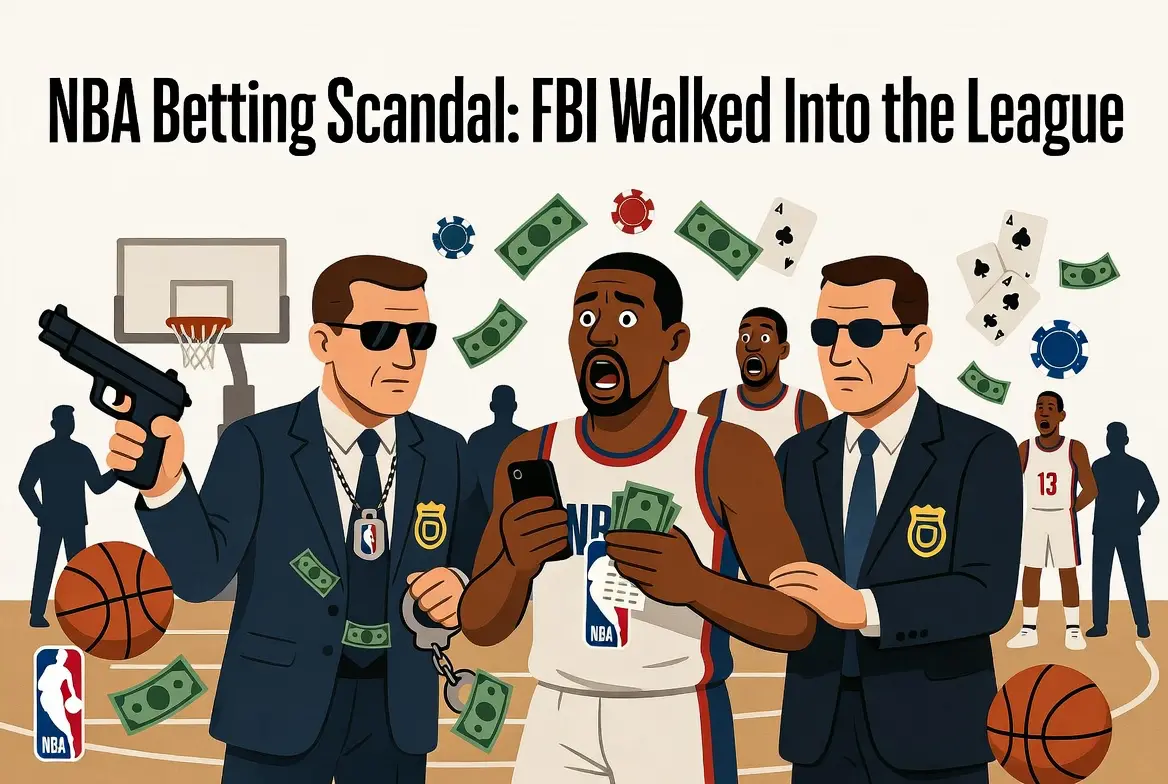
On October 23, 2025, the FBI did something American sports leagues had been quietly bracing for since the day PASPA was struck down in 2018: it arrested an active NBA player and a sitting head coach on the same morning, in two parallel federal cases, and laid out a paper trail connecting professional basketball, illegal sportsbooks, and the Bonanno crime family. Six months later, the fallout is still spreading — and most of it is landing on the betting industry, not the league.
The two names at the center are Miami Heat guard Terry Rozier and Portland Trail Blazers head coach Chauncey Billups. Damon Jones, a former NBA player who’d been working as an unofficial assistant around the league for years, sits in both indictments at once. More than 30 defendants were charged across the two cases. Federal prosecutors call it “one of the most brazen sports corruption schemes” they’ve ever taken to court.
The Rozier Prop-Bet Case: $100,000 for One “Tip”
The accusation against Rozier is specific enough to be uncomfortable. Prosecutors allege that on March 23, 2023 — when he was still with the Charlotte Hornets — Rozier told associates he would pull himself out of that night’s game against the New Orleans Pelicans early, citing a foot injury. He played about ten minutes, scored five points, and didn’t return. Bettors who’d been tipped off pounded the under on his points, rebounds, and assists.
The unusual betting activity flagged immediately. Sportsbooks froze his props. The NBA opened an internal investigation in early 2023 and cleared Rozier at the time, citing no direct evidence of wrongdoing. The FBI took a different view of the same data set. By the time the federal case landed two years later, prosecutors were prepared to argue that Rozier received roughly $100,000 in exchange for the tip and that more than $200,000 was wagered against his unders in that single game alone.
Rozier has pleaded not guilty. His attorneys argue the injury was real, the bench decision was made by the team, and the federal case rests on inference rather than transactions traceable to Rozier himself. The trial is expected later in 2026. Whatever the verdict, the prop-bet market has already changed because of him: most U.S. sportsbooks now apply tighter limits and longer review windows on player-prop unders, especially when a player is rumored to be playing through anything.
The Billups Case: Poker, the Mob, and a Side Door Into the NBA
The second indictment is wilder, and frankly more concerning for the league. Billups — a Hall of Famer, 2004 Finals MVP, and the current Trail Blazers head coach — is charged with participating in a rigged underground poker ring that prosecutors say was operated by members of the Bonanno, Genovese, and Gambino crime families in New York. The setup involved high-stakes private games, marked cards, X-ray contact lenses, and what investigators describe as a “celebrity-bait” mechanic where well-known names like Billups and Damon Jones were used to draw deep-pocketed marks to the table.
The alleged take across the scheme runs into the tens of millions over a decade. Billups, in the prosecutors’ framing, wasn’t a victim — he was a recruiter and a fixture, brought in to make the games feel legitimate. He has denied the charges. The Trail Blazers placed him on administrative leave the same day. The league has not yet ruled on his future.
Damon Jones is the connective tissue. He’s named in both the prop-betting indictment and the poker indictment, and federal investigators say it was Jones who routinely brokered the flow of inside information out of NBA locker rooms. Two of the three central defendants in the Rozier case had links to him. He was, depending on the framing, either an aspiring fixer or a one-man clearing house for confidential basketball intel.
“More Than 30 Defendants” Is Not a Detail. It’s the Story.
The headline-grabbing names are the basketball ones, but the structure of the case is what matters for the gambling industry. Federal prosecutors charged more than 30 people across the two indictments, ranging from low-level runners and bagmen to alleged organized-crime soldiers. The investigation drew in agents from the FBI’s New York field office, IRS-CI, and the U.S. Attorney’s Office for the Eastern District of New York. The Cornell Journal of Law and Public Policy walked through the early indictments in detail and called the scope “unprecedented in modern American sports.”
What that scope says, in plain terms: the same legal sportsbooks that lobbied for nationwide expansion after 2018 have created a richer surveillance dataset than illegal bookmakers ever produced — and federal investigators now know how to read it. The Rozier props case was effectively kicked off by the books themselves alerting integrity monitors. Sharp irregular action on a low-volume player prop is something a regulated market notices. That’s the upside. The downside is also obvious: the volume of legal wagering creates more incentive than ever to corrupt the people who decide outcomes.
The NFL’s Response: A Memo Nobody Asked For, Sent to Everyone
The NFL didn’t wait for its own incident. Within 48 hours of the NBA arrests, the league office circulated a fresh gambling-policy memo to all 32 teams. CBS Sports got hold of the document and reported the core rules in full: no betting on NFL games, period; minimum two-year suspension for wagering on your own team; no sharing of confidential, non-public information about players, injuries, or game plans with anyone outside the team’s authorized circle. Players who place a non-NFL bet inside any team facility — including the airports, hotels, and stadiums the team controls on game days — face a one-year suspension at minimum.
Nothing in the memo is new. The fact that the league felt the need to push it out, the same week the NBA indictments dropped, is the point. The NFL has not suspended a player for gambling since 2023. The league office clearly does not want that streak to end on the back of an NBA prosecution.
What This Means for Players (the Gambling Kind, Not the Roster Kind)
If you’re a recreational sports bettor, none of this changes the basic setup. Legal sportsbooks in regulated U.S. states are still operating normally. Player props still exist, although you’ll find them harder to bet at scale and more frequently voided when news breaks late. The NBA-NFL fallout doesn’t touch licensed online casinos at all — slots, blackjack, and live dealer offerings are governed by entirely separate regulatory tracks. Our list of trusted online casinos is unaffected, and so are the crypto casinos we cover, since none of them deal in U.S. sports-prop markets.
Where this scandal does land hard is on the conversation around responsible gambling. Two patterns are worth pulling out:
- Player-prop micro-markets are easier to manipulate than full-game lines. If a fixer can deliver one player’s behavior in one quarter, the EV swings on under bets are enormous compared to trying to fix a 200-game NBA season. Recreational bettors should know that this is the part of the market regulators are now scrutinizing hardest. Limits on prop bets are about to get tighter for everyone, not just whales.
- “Insider information” is the most expensive bet you can place. Federal prosecutors are now using the same data trails sportsbooks generate to reverse-engineer who knew what, when. The bettor who placed a $50,000 wager on Rozier’s unders ended up indicted alongside Rozier. There is no untraceable side of this market anymore. If something looks like a tip, the smart move is to assume it’s also evidence.
For anyone whose betting has been creeping up since the U.S. legalization wave — the NBA scandal is a useful reset moment. The National Council on Problem Gambling reported a 12% year-on-year jump in helpline calls through Q1 2026, with sports-betting-specific cases climbing even faster. Calls from active or recently retired pro athletes are also up. The federal indictments will deter some of the casual line-shopping for “tips” that’s been quietly normalized inside locker rooms; they will also push problem bettors deeper into denial. Both things are happening at once.
The League Office Problem Nobody Wants to Say Out Loud
NBA Commissioner Adam Silver was the most prominent league executive in America to publicly back federal sports betting legalization. His op-ed in The New York Times in November 2014 is widely credited as the moment the major leagues began moving from “we will fight legalization in court” to “we want a seat at the table and a piece of the handle.” The 2018 PASPA decision flowed directly out of that shift in tone.
What the Rozier and Billups indictments confirm is the inevitable trade-off: legalization grew the industry from roughly $5 billion in offshore U.S. handle in 2017 to more than $150 billion in legal handle in 2025. Integrity monitoring grew alongside it, but so did the surface area for corruption. There are now thousands of player props per night. There are dozens of legal U.S. sportsbooks. There are millions of new bettors. And the people producing the outcomes — players, coaches, trainers — are still paid roughly the same as before, with the same access to the same information, watched by the same number of league security officers.
Silver hasn’t backed away from his position. He won’t. But the next round of NBA collective bargaining will almost certainly feature an integrity clause that wasn’t there before, and the league’s gambling policy, currently roughly 20 pages long, is being rewritten to be longer, sharper, and more invasive. Players will hate it. The league knows. It’s still happening.
What to Watch in 2026
Three threads are still active and worth tracking through the rest of the year:
- Rozier’s trial. A conviction reshapes how prop markets are regulated nationally. An acquittal raises hard questions about whether sportsbook integrity flags can stand up to a defense lawyer with a forensic accountant.
- The NCAA’s parallel review. The college side has its own ongoing investigations into match-fixing in mid-major basketball and baseball, with at least one indictment expected in late 2026. The NBA case has accelerated the timeline.
- State-level prop-bet restrictions. Ohio, Maryland, and New Jersey have all floated rules to limit player-prop offerings or eliminate them entirely on lower-tier games. Ohio actually pulled college player props off the board in 2024; expect more states to follow on the pro side if a Rozier conviction lands.
The line that gets repeated inside the industry — by integrity monitors, by sportsbook compliance teams, by federal prosecutors when the cameras are off — is some version of “we always knew this was coming.” What no one quite predicted was that the first big domestic case would catch a Hall of Fame head coach in a poker scheme run by the Bonanno family. The NBA spent two decades selling the U.S. on legal sports betting. It’s now spending the next decade managing what that decision actually invited in.
Sources

Hi everyone, my name is Kevin and I am an author and creative manager at wagermaniacs.com. I have extensive experience in the field of gambling, as well as more than 15 years of experience playing in online casinos. These two facts allow me to be called a real expert in the field of iGaming.
My favourite online casinos: Vavada, Casino-X, Riobet and Mostbet